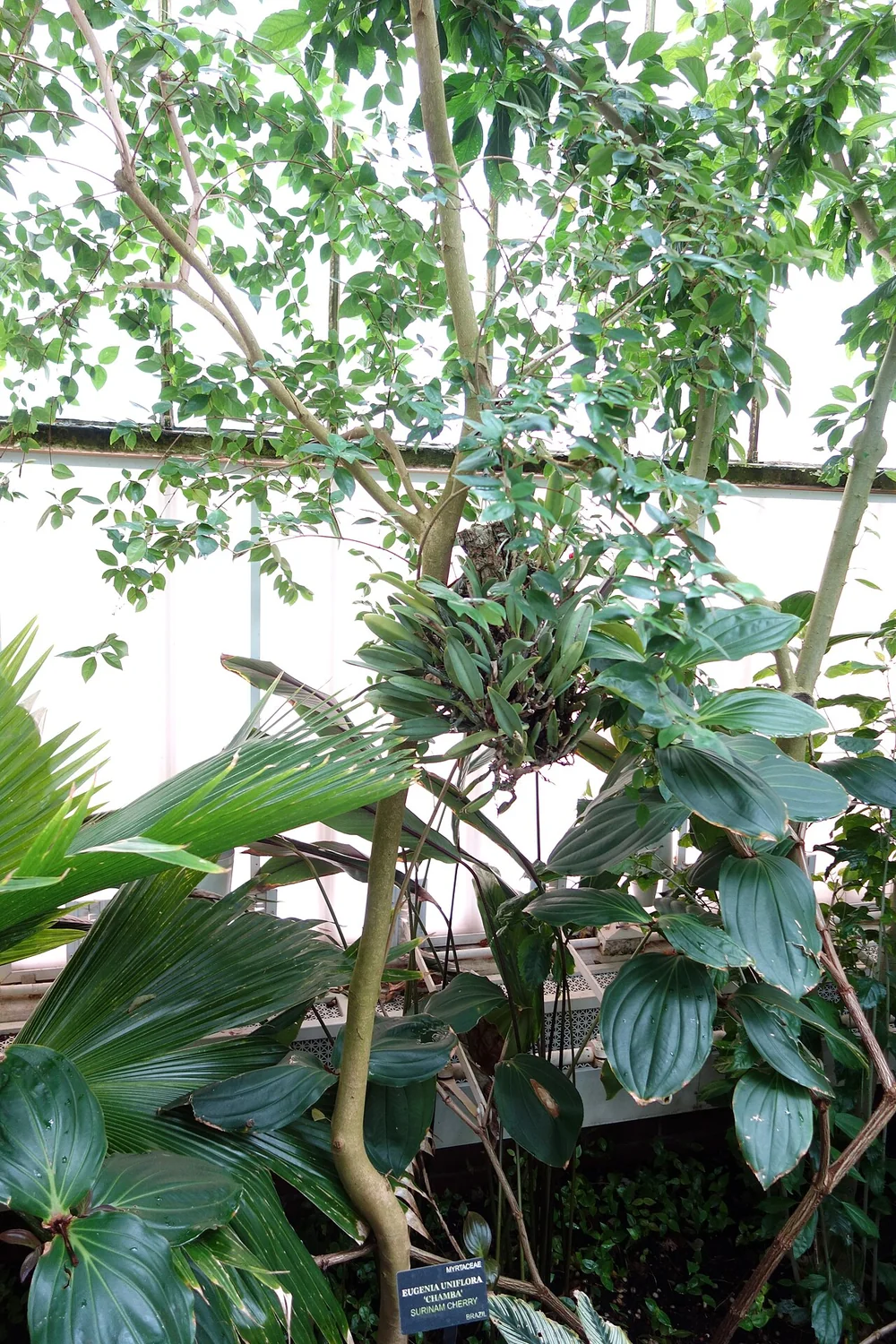
The ribbed fruit belongs to a myrtle relative
Surinam cherry has a recognisable fruit when conditions allow it to crop: small deeply ribbed fruits resemble tiny rounded pumpkins more than familiar temperate cherries. Eugenia uniflora belongs to the myrtle family and is not a Prunus cherry adapted to cold outdoor dormancy. Its small glossy leaves and fine branching can be ornamental without fruit, particularly as a container tree in a bright warm protected space. Do not assume that a compact sales plant will thrive indefinitely in a shaded office. The conditions that sustain a tree and the conditions needed for a crop both deserve consideration before purchase.
The species comes from South America and has a history of movement through tropical and subtropical cultivation. New leaves can have a bronze tone before they mature greener, providing an ordinary seasonal change in the canopy. White flowers with many stamens may be followed by red or darker fruits depending on the selected form. Keep the nursery's exact name and fruit information rather than assuming every plant sold as a Brazilian cherry has the same character. A seedling can be an interesting project, but it is not a guaranteed duplicate of a particular cultivated parent's growth or fruit quality.
Give the canopy enough daylight
Choose a sunny growing position with suitable protection from extremes. A new plant held under nursery shade should be introduced gradually to stronger direct light. In a conservatory, evaluate midday heat and airflow as well as brightness. A warm dark corner is not a substitute for a well lit site, even if the glossy foliage looks attractive there initially. Check whether the crown can still see the window as it grows taller and broader. If additional plant lighting is needed, plan its coverage and clearance around the whole tree. Normal office lighting across the room is not a dependable growing arrangement.
A summer outdoors can offer useful conditions where the weather is appropriate, but keep the seasonal return journey practical. The container needs stability, shelter from strong wind and enough space that branches do not rub against surrounding objects. Protect it from cold unsuitable to the specimen and remember that pot roots can be more exposed than roots in the ground. Indoors, avoid direct radiator heat or a position beside a window opened regularly into cold air. Sudden environmental changes can affect the canopy, and a stable bright winter address makes their consequences easier to assess.
Moisture belongs in the roots, not a standing reservoir
Use a fertile container mix that holds moderate moisture while allowing drainage and air. Keep the old collar level and move up in pot size in proportion to the occupied roots. An oversized wet tub can be counterproductive around a small young root system. Check outlet holes and remove water collected in an outer cover. A trained standard also needs a stable base and regular attention to its stake and tie. When repotting becomes necessary, support the framework so the roots are not rocked repeatedly afterward. The tree's ornamental canopy should not make access to its root container impossible.
Maintain reasonably consistent moisture while the plant grows, without leaving the lower pot permanently saturated. Check below the surface before adding water and learn the weight of the container after drainage. A bright leafy tree can use water rapidly, while the same specimen under cooler or dimmer protection may dry much more slowly. Repeated complete drying can interrupt new growth and a developing crop. If leaves wilt above wet material, investigate rather than adding another drink on appearance alone. A dry nursery core and damp surrounding mix may need different handling from an evenly moist root ball.
Decide how much clipping fits the purpose
The tree can respond to shaping, but a formal constantly clipped crown and a natural flowering canopy are different aims. Frequent tip removal may reduce the flower and fruit display. Thin or shorten selected shoots with enough foliage left to support the plant, and keep light reaching more than the exterior. Confirm whether any vigorous growth is desirable before letting it alter the main framework. Feed active growth with a suitable container product at its stated rate, considering nutrients in fresh mix. More food cannot replace the light needed to support a crop or undo the effects of continuously wet roots.
Fruit maturity differs from a simple rule that every red fruit is ready. Cultivated forms and the intended crop use matter, and ornamental nursery treatment must be checked before eating anything supplied with the tree. Seeds and other plant parts should not be assumed edible because the ripe fruit has a documented food use. Keep fallen material away from pets and children. Surinam cherry can spread in some warm regions, so local horticultural guidance matters before planting it outdoors or distributing seedlings. Controlling discarded fruit and seed is part of responsible container maintenance, even when the tree is mainly grown for its glossy foliage.
Learn the ordinary bronze flush
Fresh bronze growth is a useful feature to recognise so it is not automatically treated as a deficiency. Compare new and old leaves, look for actual insects or distortion, and examine the root environment if the whole canopy changes. Scale and other small pests can hide along twigs, particularly on a dense clipped tree. Inspect a plant returning from summer outdoors before it joins other indoor specimens. Keep dust and dead debris from obscuring the surfaces being checked. A dated record of pruning, moving and watering helps separate a predictable growth flush from a developing problem that needs a specific response.
Surinam cherry can be a considered gift for someone who enjoys tropical fruit diversity or has a personal connection with the species. Its meaning can be the recipient's own memory of a garden or food tradition, rather than a universal claim attached by the seller. A housewarming or retirement gift may suit an established conservatory grower who wants another tree to observe. It is less appropriate for a person with a dim office and no plan for a growing pot. Ask about the actual site, the willingness to handle fruit and any local planting concerns before selecting a large specimen.
Give practical information with the plant
Keep its Eugenia uniflora label and any named fruit form together with the supplier's treatment history. A manageable pot with accessible drainage is more useful than a decorative vessel that conceals standing water. Explain whether the tree has been clipped for foliage or allowed to develop a looser fruiting framework. During the first season, focus on reliable new leaves, root moisture and a workable annual location. The ribbed fruits are an interesting possible extension of that success. They should not become a demand that a recently moved small tree reproduce a tropical garden crop under inadequate indoor light.