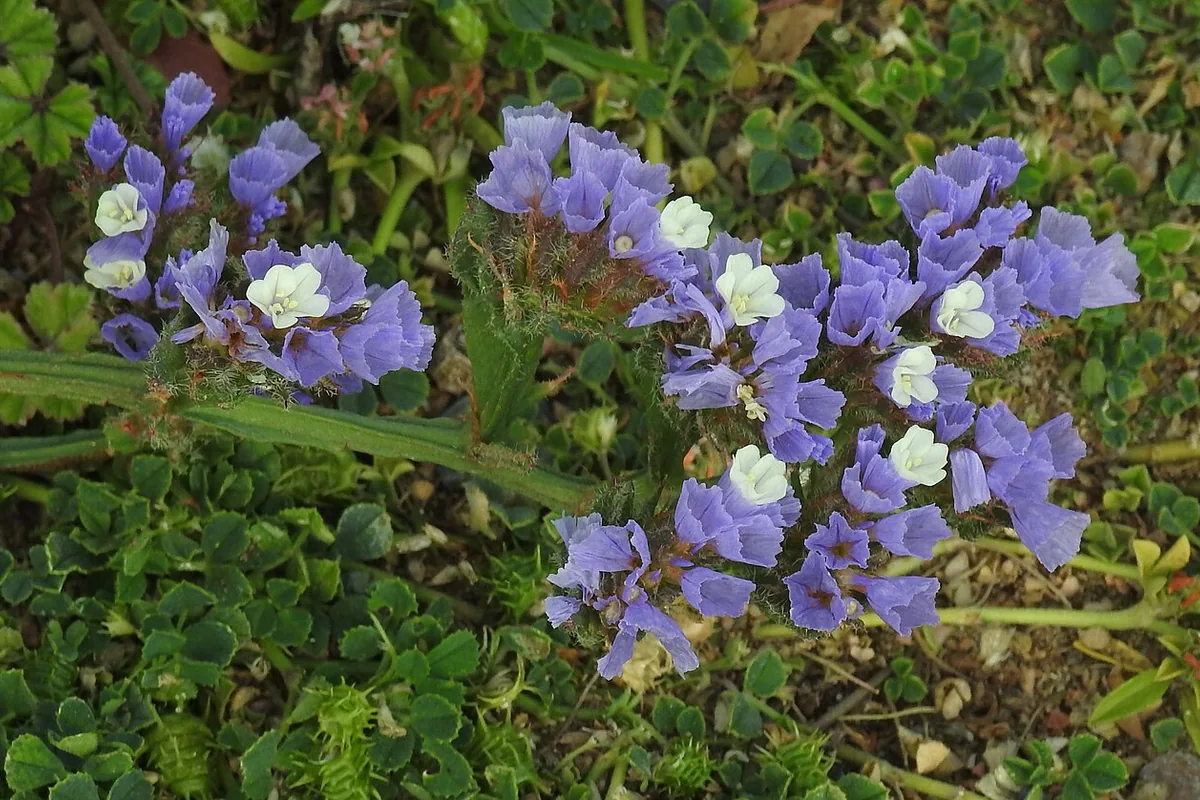
Annual Statice earns its place in a container through papery coloured calyces held in branching sprays above a basal leaf rosette. The botanical name is Limonium sinuatum, which is useful when buying plants because common names can cover several different garden subjects. Botanically it belongs to the Plumbaginaceae family. Begin by looking at the whole plant rather than choosing solely from the largest open flower. A compact young framework with intact leaves and visible new growth is easier to establish than an overgrown specimen squeezed into a small nursery sleeve. Check the label for the mature size of the particular selection, then choose a position where its characteristic outline can develop without continual trimming or crowding by stronger neighbours. Recorded flower colours include blue, gold or yellow, pink, purple or lavender, red or burgundy and white, although a single named selection will show only its own colour pattern.
Choose full sun where air can move freely through the upright sprays for annual statice. Air movement around the crown is particularly useful for a plant adapted to relatively open conditions. A sunny position does not compensate for compost that stays saturated underneath. Keep the pot clear of a wall that channels roof water into it, and leave the leaves exposed to ordinary drying air after rain. Look at where the sun actually falls on the foliage, not simply the direction in which a balcony faces. A deep roof, a neighbouring building, or a newly arranged taller plant can alter that exposure substantially. A short record of the morning and afternoon conditions gives a more useful basis for choosing the location than repeatedly moving a flowering pot from one attractive corner to another. Make any large change gradually so existing leaves have time to adjust.
The main container consideration for annual statice is this: a deeper draining container suits the rosette and substantial roots better than a shallow dish. Use a container mix with a stable open structure and avoid adding heavy garden soil to an already dense bagged compost. A porous mineral component may improve a mix that otherwise stays wet, but a layer of stones at the bottom does not replace drainage holes or correct an unsuitable mix. Before planting, inspect the nursery root ball and loosen only obvious loose circling outer roots that can be eased without tearing the main structure. Do not wash away the mix merely to make the roots look tidy. Keep the stem bases and crown visible at their established depth. Water the completed planting once, let it drain, and check that neither the pot nor a decorative cover has trapped a reservoir underneath. The container should remain practical to reach for later care.
The watering priority for annual statice is specific: moderate water while new stems grow followed by some drying at the surface. A slightly dry surface is useful information, but it does not mean the entire root ball must become dust. Check lower in the mix and compare the pot weight before watering. Give a thorough drink when needed, allow the excess to drain, and wait for the next appropriate drying interval rather than adding a daily splash. Temperature, wind, canopy size, and the material of the container all change the interval. A terracotta pot in moving air behaves differently from a glazed pot in shelter even when both contain the same species. After rain, inspect the mix rather than assuming every part of the root ball has been watered evenly. If water immediately runs down a gap at the edge of a dry root ball, apply smaller repeated amounts until the mix takes it up.
When managing flowers on annual statice, cut flower sprays while fresh and avoid leaving old stems wedged across the crown. Feed in response to active growth and the instructions for the actual product, allowing for any fertilizer already included in fresh potting mix. More feed cannot correct unsuitable daylight, a collapsed root ball, or the wrong season. Check a plant before cutting it: a branch carrying several unopened buds should not be removed simply because one nearby flower has finished. Use clean suitable tools, remove loose dead material from the mix surface, and leave enough functioning foliage to support the next stage of growth. The reference lists fall and summer among its flowering periods, but a balcony microclimate can shift that timing.
Plan around this seasonal pattern for annual statice: usually displayed as a seasonal plant where cold or wet winter conditions are unsuitable. Plan to renew the display when the annual has completed its natural cycle. Collecting seed, where appropriate, belongs near the end of that cycle and generally reduces the energy available for more flowers. Empty tired planting material from a pot before the next crop, clean the container, and begin with suitable fresh mix rather than planting into an old congested root mass. The botanical reference records its origin as Mediterranean to western Sahara. Keep local conditions in view rather than copying a month from a garden in another hemisphere. The useful cues are temperatures, the direction of new growth, and whether the plant is extending stems or entering a rest. When moving a protected plant outdoors, allow it to adjust to brighter light and stronger air movement before putting it in its final display position. A label recording the exact plant and the season it was established helps make the next decision less uncertain.
For a new annual statice plant, sow into individual modules and avoid repeatedly disturbing the young root system. Start with clearly identified material because a photograph of a flower is not enough to establish the identity of a seedling or cutting. A named selection may not retain its colour or compact habit when raised from seed, even if the species name is correct. Give young roots their own manageable container and inspect moisture at their scale rather than applying the routine used for an established flowering pot. Grow new material separately until it can be checked for unwanted insects and its growth habit becomes clear. Keep only the number of plants that can be spaced and maintained properly.
Keep one particular point in view when inspecting annual statice: a buried rosette can rot when damp old leaves and rich mix collect over the central growing point. Compare the newest growth with older leaves and look at the root zone before choosing a response. An isolated damaged flower after rain tells a different story from a whole canopy losing firmness while the mix remains wet. Check both leaf surfaces, the stem bases, and the drainage outlets, then remove loose decaying material that obscures what is happening. Change one relevant growing condition at a time and watch the subsequent growth. This makes it easier to distinguish a normal seasonal change in Limonium sinuatum from a repeated problem that the container arrangement is creating.