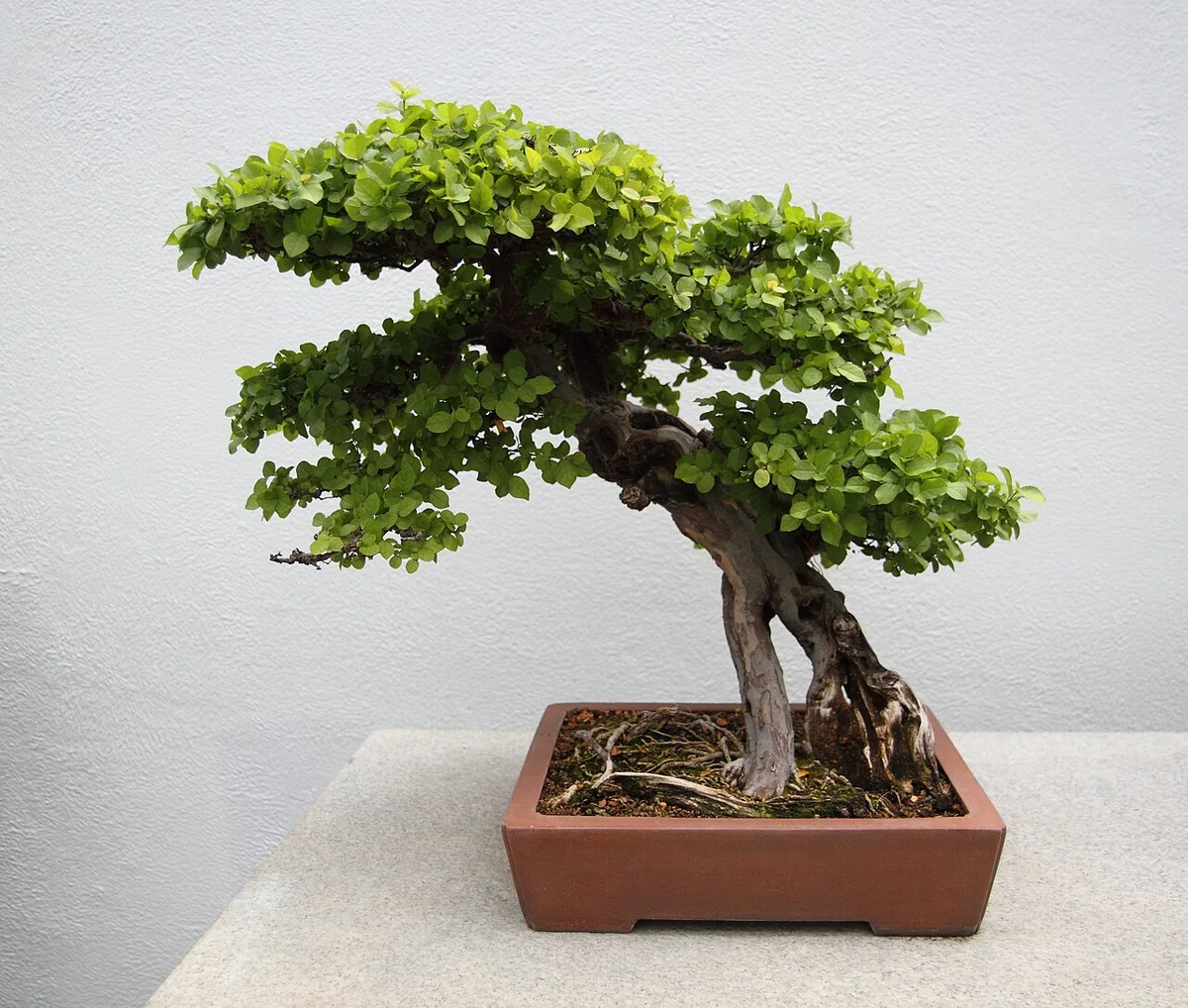
Chinese sweet plum is not a tiny orchard plum
Chinese sweet plum bonsai usually belongs to Sageretia thea, also encountered in horticulture as Sageretia theezans. Its fine branching, small leaves and textured ageing bark can suit a compact tree composition. The common name should not lead an owner to treat it as a miniature Prunus plum or to assume that retail fruit is intended for eating. It belongs to a different botanical family. The attraction indoors is the maintained woody structure and fresh foliage, supported by appropriate light and root care. Its small size does not make it independent of the seasonal and daily conditions around the container.
The plant comes from Asian regions and grows naturally as a shrub or small tree rather than as a finished bonsai. Nursery pruning and root restriction create the familiar scaled presentation. Young leaves may show a reddish tone before becoming greener, a change that should be understood as part of growth rather than automatically called a deficiency. Compare the supplier's botanical label with any general bonsai instructions attached to the pot. A small juniper, a serissa and a sageretia may be sold side by side, yet their temperature and moisture requirements are not interchangeable.
Brightness must reach the fine branches
Choose a bright protected position where the tree receives useful daylight across its canopy. A sunny window may need adjustment for intense summer heat, while a position well behind glass can be too shaded. Look at the length and strength of new shoots rather than judging only the old bark. The desk where a tree looks best during a meeting is not necessarily where it can grow. If the room cannot provide adequate winter light, supplementary plant lighting should be planned properly. A household bulb shining from the opposite side of the room is not a reliable substitute.
A suitable summer outdoors can provide good light and air, with gradual introduction after protected indoor conditions. Shelter the tree from severe wind and unsuitable cold, paying particular attention to its shallow pot. The roots heat and cool faster than the trunk's sturdy appearance suggests. A bright cool protected winter arrangement may be appropriate, but darkness is not a resting requirement. Avoid hot radiator air directly beside the crown. Pick a stable annual arrangement and make deliberate seasonal moves rather than shifting the plant repeatedly whenever the leaves look less glossy for a few days.
Fine roots need timely water
Repeated complete drying is particularly risky for a small sageretia. Check the occupied root ball before it becomes a hard dry block, especially during a warm bright growing period. Apply enough water to wet the roots evenly and let the excess drain. The interval can be short in a shallow granular pot but longer in a dense nursery medium. Learn the actual setup instead of following a universal instruction to water every day. Surface moss may help the composition visually, but it should not hide the only place where the keeper can judge what the roots are experiencing.
Persistent saturation is a different problem, not a safe alternative to drought. A decorative saucer should not become a permanent reservoir around the drainage holes. Look beneath the upper layer when a pot seems difficult to interpret, and compare its weight after watering with the weight before the next drink. If leaves wilt above wet medium, check drainage and root condition. Do not add a stronger fertilizer as an emergency response to a root system that may be struggling for air. A recently purchased tree should settle before unnecessary work changes both its soil and its growing position simultaneously.
Branch refinement starts with functioning growth
Let the tree make enough new growth to show that it has adapted, then shorten suitable shoots to maintain the intended outline. A dense clipped outside can shade the inner branches, so light distribution belongs in the shaping decision. Remove dead twigs carefully and avoid declaring a bare living branch dead immediately after a move. Any wire already on the tree should be checked as stems expand. Fine bark can be marked by neglected ties. Major bending and heavy pruning are skilled tasks that need a sound plant, rather than being a shortcut to make a weak specimen resemble an exhibition photograph.
Root pruning should be undertaken at an appropriate active growing time with attention to how much root the existing canopy can afford to lose. A beginner does not need to replace every particle of old medium at once to begin responsible care. Use a draining bonsai mix suited to the growing environment and secure the plant against movement after repotting. Feed modestly when growth is established, observing product directions. New roots, young shoots and an ornamental crop do not all need to be forced together. A well functioning foliage canopy is already a meaningful result during the first season in a new home.
Small changes are easier to diagnose
Leaf drop after relocation can follow a combination of moisture and environmental changes, so record what happened before responding. Compare the root ball, the window exposure and the temperature around the pot. Inspect sheltered leaves and branch junctions for pests, particularly after time outdoors. Do not shift the tree between several rooms while also changing feed and water frequency; that produces a confusing series of new conditions. One justified adjustment followed by observation is more informative. The attractive bark is useful to admire, but it should not distract attention from the fine living root system supporting the whole composition.
As a personal gift, Chinese sweet plum can suggest an interest in gradual development: the keeper watches fresh leaves and a changing branch structure rather than receiving a fixed ornament. It does not need an invented promise of luck or a claim that bonsai automatically creates calm. A birthday or retirement gift can work well if the recipient has asked for a bonsai project and can provide suitable light. It is unsuitable for someone whose ordinary travel pattern leaves the pot unchecked for long periods. Choosing an appropriate keeper is as important as choosing an appealing trunk.
A useful first year
Keep the botanical label, the nursery's medium information and the dates of recent root or branch work with the tree. Give the recipient a way to water thoroughly and drain safely without dismantling an elaborate display. Do not encourage fruit tasting from an ornamental bonsai whose treatment history is unknown. Through the first year, learn the relationship between light, root moisture and new shoots before pursuing advanced styling. A modest sageretia with accessible roots and a stable growing address is a better learning companion than a highly shaped tree continually being rescued from inappropriate display positions.