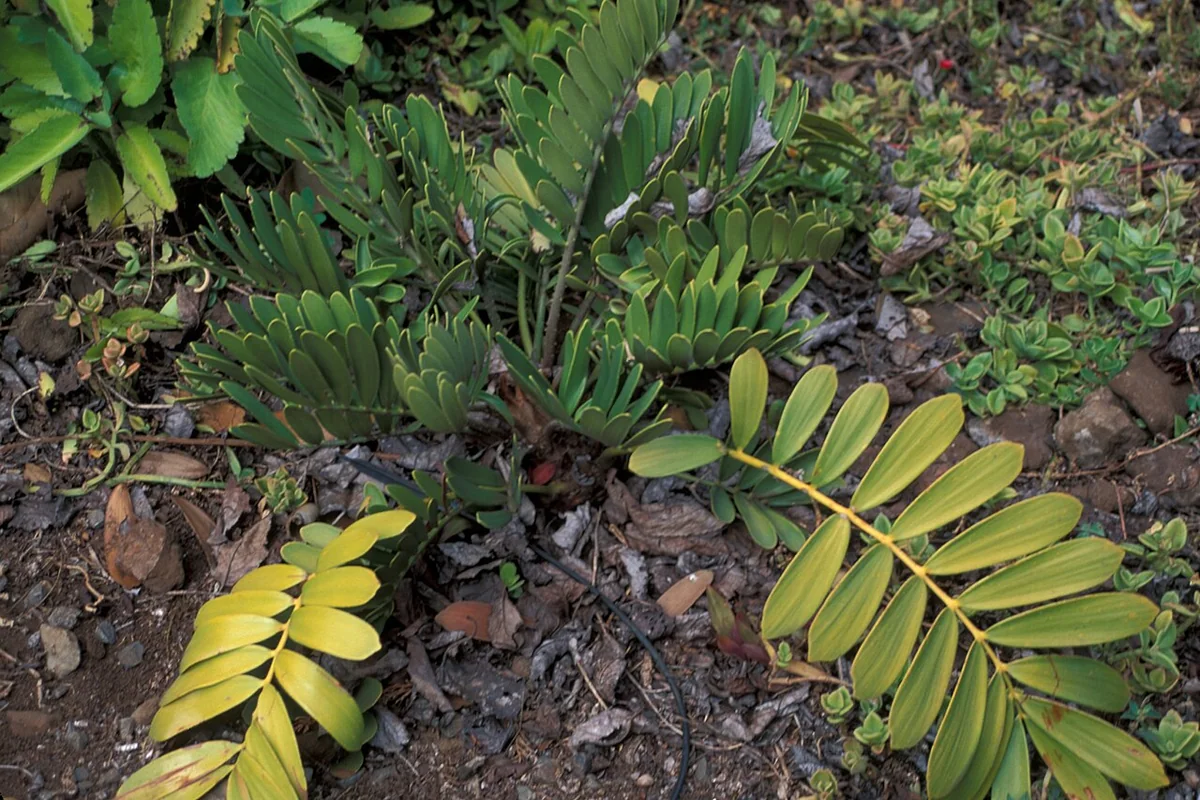
Coontie and Its Southeastern American Story
Coontie is an architectural plant on a relatively low scale. Zamia integrifolia carries arching divided leaves from a short, largely underground stem, creating a firm green rosette rather than the exposed trunk of a conventional indoor tree. It is a cycad, not a palm or a fern. That distinction explains both its reproductive structures and its slow rhythm of growth. A container can be attractive in a bright collection space, but the plant is toxic if eaten. It should therefore be selected with household access in mind, rather than offered casually as a small apparently harmless version of a tropical palm.
The species is native to the southeastern United States, especially Florida and parts of Georgia. Its local ecological story includes its role as a host for the Florida Atala butterfly. That relationship belongs primarily to outdoor cultivation within an appropriate range; an indoor pot is not automatically a butterfly habitat. Historical accounts also connect coontie with processed starch, but traditional processing should never be interpreted as evidence that an ornamental plant can safely be eaten raw or prepared casually at home. For a houseplant guide, the useful history is the distinction between a culturally known native species and a safe food plant.
A Bright Container Position
Choose a bright indoor location, with direct sun introduced gradually if the nursery foliage was shaded. A sunny room or protected conservatory is more suitable than a dark office shelf. The leaves spread outward from the base, so the plant needs floor or stand space even when it has little height. Do not judge footprint only from the diameter of the pot. A low rosette beside a chair can be repeatedly kicked or brushed by bags. If animals investigate containers at floor level, the toxic nature makes that placement unsuitable regardless of how well the available light would otherwise match the plant.
Water deeply enough to reach the root system, then allow a meaningful drying interval. Coontie tolerates dryness better than a continually moist tropical foliage plant, but a restricted pot still needs observation during active growth. Avoid a schedule that ignores changes in season and exposure. Cool shaded medium can remain wet much longer than a sunny summer pot. Check beneath surface material and remove any surplus from an outer container. A thick underground stem should not be kept in stale water simply because the leaves remain firm. The root environment can deteriorate before the canopy shows an unmistakable response.
Underground Stems, Leaf Flushes, and Safe Cleanup
An open sandy container mix with working drainage suits its structure. Add organic retention thoughtfully rather than eliminating all air spaces in pursuit of a richer medium. Use a pot matched to the roots and preserve the established level of the underground stem during repotting. Constantly disturbing a slow cycad in search of faster growth is counterproductive. A sound plant may remain in the same container until root crowding or deteriorating mix actually warrants a change. Have the next pot ready before lifting it, support the root mass, and avoid leaving living tissue exposed while a decorative arrangement is improvised.
Expect leaves to emerge in flushes rather than at a steady weekly rate. The young fronds need protection while they expand and harden. Their final length and strength depend partly on the conditions during that stage, so establish appropriate light before a flush begins. A quiet interval afterward is not an instruction to increase water and fertilizer repeatedly. Feed modestly during active growth with a suitable labelled product. The plant's compact appearance should be maintained through suitable conditions, not by clipping every leaflet or removing healthy fronds each time the rosette becomes wider than its original nursery presentation.
Leaf Flushes, Pest Identification, and Seed Precautions
Remove a leaf only when it is spent or its condition justifies sacrificing useful green area. A cycad crown should never be cut as though it were the tip of a branching shrub. Cleaning can be gentle, with supported leaves and a soft damp cloth. Look for scale beneath leaflets and near the protected base. If pests are found, isolate the pot while identifying an appropriate response. In an outdoor Florida planting, caterpillar feeding can have a specific ecological context; indoors, damage still needs to be identified rather than attributed automatically to the same butterfly story. The setting determines how that history applies.
Cones are reproductive structures, not flowers. Male and female plants are separate, and a single indoor specimen may never produce the complete sequence of seed formation. Any attractive seeds or fallen plant material must remain inaccessible to children and animals because toxicity is a central concern with cycads. Do not use the historical starch connection as a practical preparation guide. If ingestion is suspected, seek professional medical or veterinary advice promptly. Safe housekeeping includes disposal and storage of removed material, not merely positioning the pot on a stand while leaving clippings or seeds in a reachable waste basket nearby.
Regional Meaning without Overlooking Toxicity
Coontie can be a meaningful agreed gift for someone interested in Florida native plants or regional conservation. A note can discuss its real ecological relationship with Atala butterflies while making clear that an indoor pot does not perform the same function as an appropriate outdoor host planting. Personal meanings of rootedness or continuity are reasonable if identified as the giver's interpretation. The recipient needs sufficient light and a household where toxic plant material can remain excluded. It is not an ideal surprise for someone who assumes all small palms are pet-safe. Include the scientific name and an unambiguous account of the cycad identity.
The long-term goal is a sound rosette renewing at its natural pace. Observe each new flush, keep the underground stem aerated, and resist repeated interventions during quiet periods. If a suitable outdoor setting exists within the plant's appropriate range, that can offer a different opportunity from indoor display, subject to local conditions and sourcing guidance. In either setting, choose responsibly propagated material. Zamia integrifolia has a specific southeastern American history that deserves more than a generic exotic label. Good cultivation respects that history, its distinctive growth, and the practical limits imposed by a toxic ornamental in a shared household.