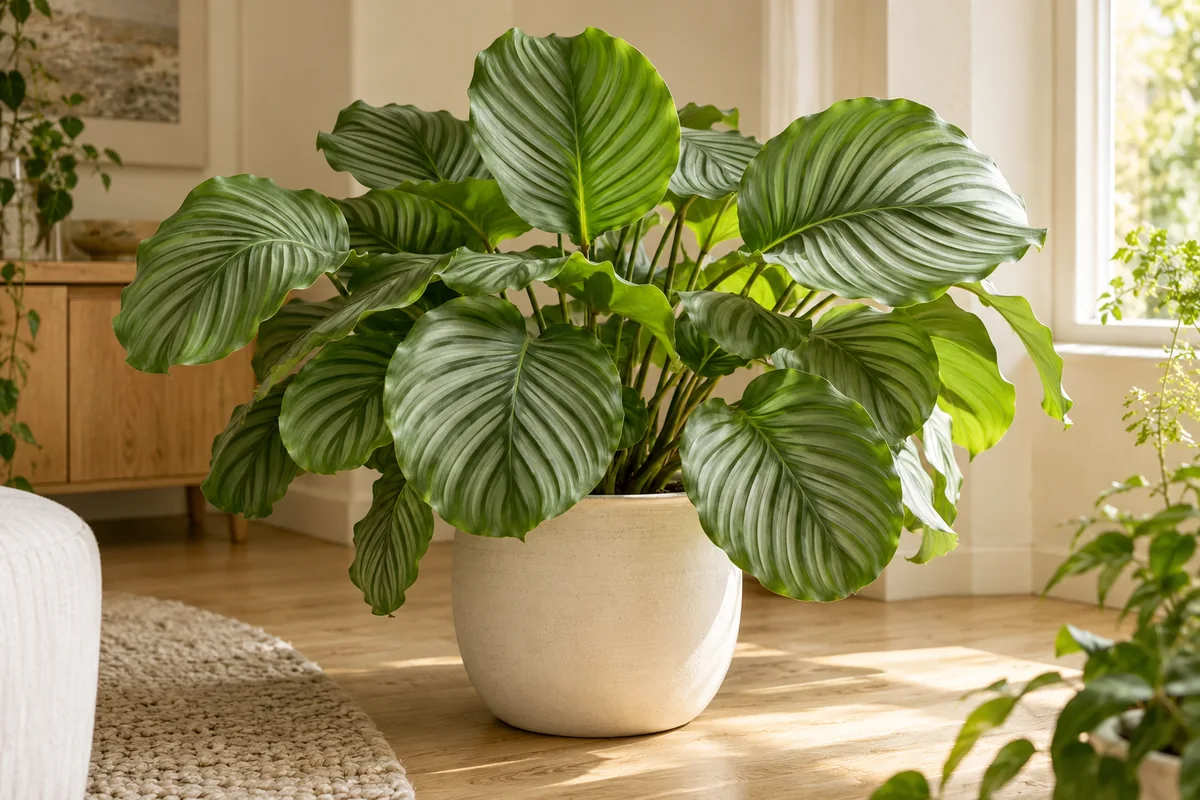
One broad leaf can make calathea orbifolia feel like a much larger plant than its pot suggests. The pale bands follow the curve of the blade, and a fresh leaf opens with a smoothness that old creases rarely recover. Keeping that new foliage cleanly formed depends on the setting around the whole plant. Dry airflow, abrupt sunshine, and uneven root moisture can all show along the edges. This is a good plant to place where you can inspect it easily. A stable bright room with a clear watering arrangement offers more value than a dramatic display position that makes the roots and growing crown hard to reach.
The plant is now commonly placed in the genus Goeppertia, though calathea orbifolia remains a familiar name. It appreciates bright indirect daylight and protection from strong direct sun. A sheer curtain can soften an exposed window, while a sheltered east window may offer useful gentle light. Move gradually if the current position is too dim. A leaf formed in shade can develop pale dry patches after sudden intense exposure. Keep the pot clear of cold glass and hot vents. The broad leaves need lateral space, so avoid squeezing the plant between furniture where the outer blades are constantly folded or brushed.
Keep the mix gently moist and aerated, allowing the upper surface to begin drying before the next thorough watering. Do not leave the entire root ball dry for a prolonged period. Use a finger or wooden probe to check below the surface, then apply water evenly and allow excess to drain. Empty the outer planter or saucer afterward. A large decorative container can make the nursery pot difficult to judge, so lift it out when practical. If the deeper mix remains heavy and wet, wait and investigate drainage. Curled leaves are a reason to check conditions, not an automatic instruction to add more water.
Water with lower mineral content can be helpful where the household supply leaves substantial deposits or contains substances to which the foliage is sensitive. Check local water information and use a suitable alternative when needed. Standing tap water does not remove dissolved salts, so it should not be treated as a universal solution. Brown edges can also develop from irregular moisture, excess fertilizer, and dry indoor air. Review the whole arrangement rather than changing the water alone and expecting old marks to disappear. New leaves show the result of current care. Existing dry tissue remains a record of earlier conditions even after the root zone improves.
Use an open mix that holds a steady supply of moisture without becoming dense. A suitable houseplant mix adjusted with coarse structured ingredients can work, with the texture matched to the pot and room. Repot when roots fill the container or the old mix deteriorates, increasing the diameter modestly. Keep the growing crown at its previous level and settle material around the roots gently. Division is possible during active growth when the clump has distinct rooted sections. Each division needs enough roots and leaves to establish. Small pieces placed in deep oversized pots are harder to water sensibly than rooted sections in appropriately modest containers.
Calathea orbifolia appreciates sustained humidity, especially where heating makes the air dry. A humidifier maintained according to its instructions can help create a more suitable room. Misting provides only a brief local change and can leave spots on the broad leaves. A naturally humid bright room may suit the plant well, provided it has gentle circulation and a stable temperature. Keep leaves away from surfaces that remain wet. Grouping plants can slightly alter the immediate setting, yet it does not replace adequate light or solve a very dry room by itself. Choose a practical arrangement that remains easy to inspect and clean.
Wipe the large leaves carefully with a soft damp cloth, supporting each blade underneath. New growth emerges rolled and should unfold without being pulled open. A crease caused at that stage stays visible as the leaf expands. Feed modestly during active growth according to the product directions, taking account of nutrients already in fresh mix. Strong applications can add salts faster than the roots use them. If deposits appear, review the feeding rate and flush a freely draining pot when appropriate. Remove fully old leaves near the base with a clean tool, taking care around the new shoots gathered at the crown.
Evaluate the plant through its newest leaves and the consistency of its drying pattern. A few old brown edges do not mean every condition is wrong. If fresh leaves repeatedly open with dry margins, examine humidity, root moisture, and water quality together, then make a measured adjustment. Photograph the plant occasionally so gradual improvement is easier to see. Calathea orbifolia does not need a crowded decorative setting to be striking. Its broad striped blades provide the detail. Soft daylight, a gently moist open root zone, and enough space for each leaf to unfold let that natural pattern remain clear without a complicated sequence of treatments.