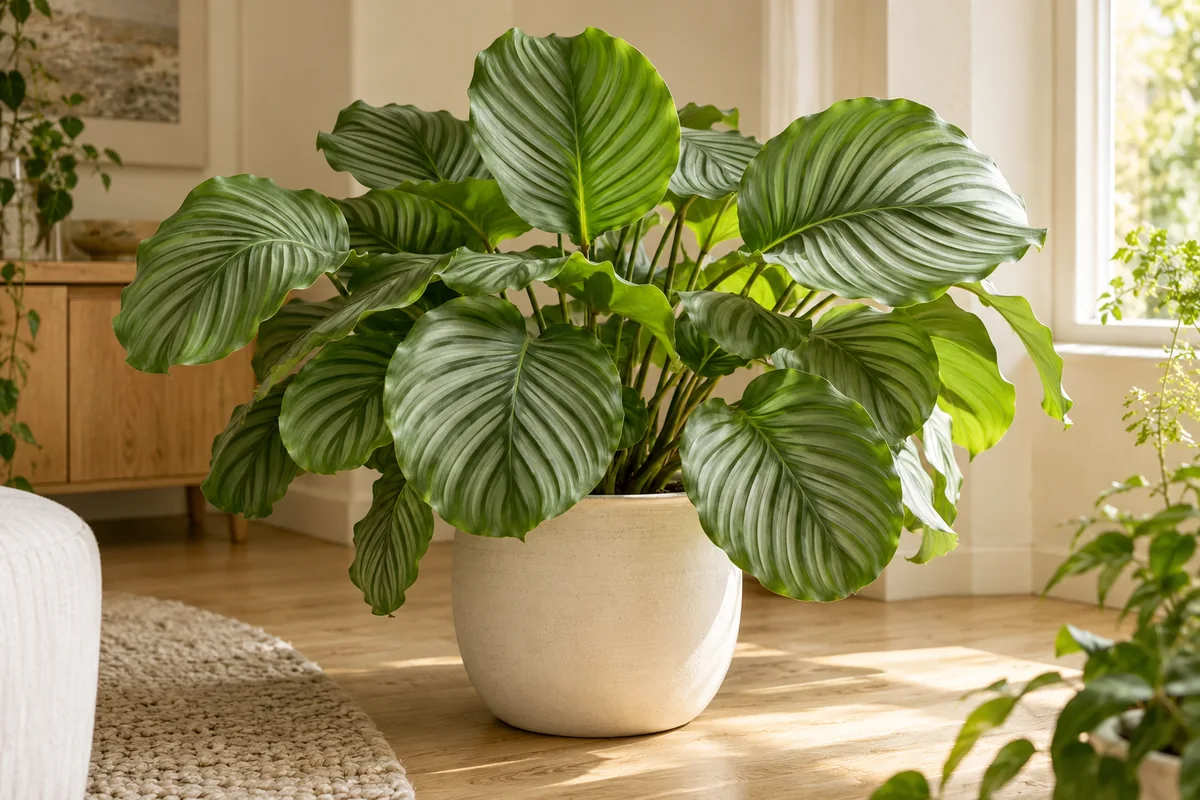
The broad leaves of a calathea can make a crowded pot look ready to split long before its roots offer sensible divisions. Look at the base rather than counting leaves. A useful division contains a real growing section with attached roots, not a handful of leaf stalks cut away from a shared center. Many familiar calatheas are now listed botanically as Goeppertia, including Goeppertia orbifolia. Their exact structure varies, so identify your plant and inspect it carefully. Division is most practical for a mature clump with several clear growing points. A young specimen with one small center usually benefits more from uninterrupted growth than from being divided.
Wait for an active growing period and prepare the new pots before lifting the plant. Calatheas can react visibly to root disturbance, so avoid combining division with a move to a different room or a sudden change in light. Water in advance if the mix is dry, allowing it to become evenly moist and then drain. A sodden root ball is awkward to handle and makes damaged tissue harder to distinguish. Choose containers only large enough for the divisions and some surrounding mix. Fresh potting material should hold moisture while retaining open spaces, with drainage holes providing a clear route for excess water to leave each container.
Slide the clump out while supporting its base, loosening the pot rather than pulling the leaves upward. Set the root ball on a tray and remove only loose outer mix. Find the natural lines between groups of growth and trace each group down to its roots. A dense web of fine roots may hide the connecting structures. Work slowly, rotating the clump instead of tugging harder when it resists. You do not need to expose every root. The aim is to understand the connection well enough to preserve substantial rooted sections. Keeping a generous portion together often gives a more reliable result than producing many tiny plants.
Use your fingers to separate sections where they part readily. If a firm connecting piece needs cutting, use a clean sharp blade and make the smallest useful cut. Never split through a growing center merely to make two halves of equal size. Retain as many sound fine roots as possible and keep the pieces shaded while you work. Remove only tissue that is clearly soft or collapsed. Avoid washing the entire root system unless there is a specific reason to remove old material, since vigorous washing can add unnecessary disturbance. Calathea divisions should resemble smaller established plants with a coherent base, not loose bundles of leaves waiting for roots.
Set each section at its previous depth in a prepared pot, with the growing centers close to the surface. Add fresh mix around the roots and settle it gently, leaving enough space below the rim for watering. Deep burial can keep leaf bases wet and makes the plant harder to inspect. Water slowly until the mix is settled, then empty the saucer after drainage. The new container should feel stable without the material being packed hard. If a division has a tall canopy, temporary gentle support is preferable to burying it deeper. Keep labels visible so you can track which section received the larger or more disturbed root portion.
Give the divisions a sheltered place with bright indirect light and steady indoor warmth. Direct sun, hot vents, and cold window glass add demands at the moment the roots are recovering. Keep the mix lightly moist, checking its condition before every watering. The smaller root system may remove less water than the original clump, even when the leaves seem slightly curled. A loose cover may help in a dry room if you ventilate it and avoid overheating, but it should not create a constantly dripping enclosure. Use the same suitable water source the plant tolerated before division where possible. Sudden changes make it difficult to understand any new leaf marks.
Allow time for the old leaves to settle and for new growth to reveal the result. A few damaged edges after handling do not require immediate repotting or heavy feeding. Trim only fully spent leaves and keep the growing centers visible. Check for fresh rolled leaves and gradually improving leaf posture. If a division remains limp while its mix stays wet, inspect drainage and the condition of its base. Adding water on top of wet mix can prolong the problem. Avoid lifting the plant repeatedly to inspect roots. A steady environment and careful surface checks provide better information without interrupting each small advance below the soil.
Resume ordinary feeding only once the divisions are established and producing consistent growth, following the product directions. Move them gradually to their intended positions, keeping similar light and warmth during the transition. Do not rush into larger pots as soon as a leaf appears. The root system needs to occupy the current container before extra volume becomes useful. Record the date, the number of growing sections retained, and the moisture pattern after potting. Those details will help you decide whether a future clump is ready for division. With calatheas, preserving a substantial rooted section is a more practical ambition than collecting the largest possible number of new plants.