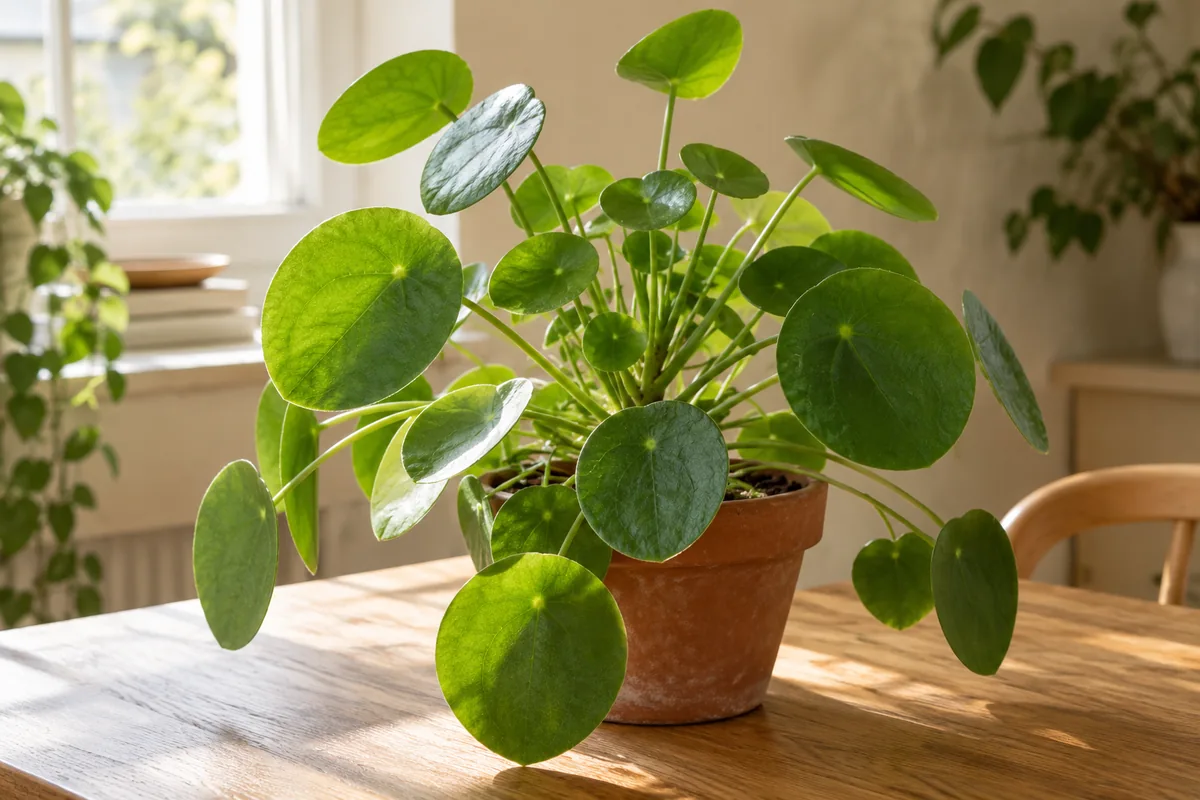
The round leaves of Chinese money plant make every change in direction easy to see. A pot left in one orientation can develop a distinct front, with nearly all its leaves looking toward the window. That is normal growth toward light rather than a mysterious fault in the plant. A little rotation and a brighter position can produce a more balanced outline over time. Pilea peperomioides also changes character as it matures, developing a short upright stem and small offsets around its base. Letting those features become part of the display often works better than trying to preserve the exact appearance of a newly purchased plant.
Choose a bright position with indirect daylight or gentle morning sun. Strong afternoon exposure can mark leaves that developed in a sheltered room, especially when the pot sits close to hot glass. Introduce brighter conditions gradually and watch new growth. A position far from the window often leads to long leaf stalks and a leaning stem. Turn the container a little at regular intervals rather than rotating it only after the plant has become dramatically one sided. Keep enough space around the foliage for the leaves to spread without pressing against a wall, curtain, or neighboring pot that blocks useful light.
Allow the upper mix to dry between thorough waterings. Check beneath the surface before adding water, then wet the root ball evenly and allow excess to drain. A small pot near a bright window may dry much sooner than a large glazed pot in a cool room. The leaf stalks may soften when the plant is thirsty, yet a heavy wet container needs inspection before another soak. Empty the saucer or outer planter promptly. Repeated small splashes can create uneven moisture, leaving the lower roots dry while the stem base stays damp. A complete watering followed by a sensible drying interval is easier to read.
Use a loose potting mix and a container with drainage holes. A modest proportion of coarse material helps prevent a fine mix from becoming compacted, with the exact texture adjusted to the room and watering routine. Repot when roots have occupied the available space or offsets make the container crowded. Increase the diameter only slightly and keep the main stem at its original depth. Deeply burying the stem to hide a bare section is not a useful shortcut. A small stake can support a leaning mature stem while the light is improved. Check ties frequently so they remain loose as the stem thickens.
Older lower leaves sometimes yellow and drop as the central stem grows. A few losses over time can leave a visible trunk without indicating that the whole plant is declining. Several leaves changing quickly deserves a look at recent moves, soil moisture, and drainage. New leaves provide useful evidence: their size, firmness, and spacing show how the plant is responding to current conditions. Existing curled or marked foliage may never become perfectly flat again. Avoid continually changing the care routine to repair old surfaces. Make a reasonable adjustment, then allow enough time for fresh leaves to reveal its effect.
Offsets arise near the base and can remain to form a fuller clump. If you want separate plants, wait until an offset has several leaves and an identifiable root system before removing it. Gently expose its connection to the parent and separate it with a clean tool, preserving as many roots as practical. Place the division in a small draining pot with suitable mix. Keep the mix lightly moist while roots settle, without leaving the container saturated. A tiny offset in a large decorative planter is difficult to water well. Growing it in a modest inner pot makes both moisture checks and eventual repotting simpler.
Feed modestly during active growth according to the fertilizer instructions, remembering that fresh mix may already contain nutrients. Fertilizer cannot correct long leaf stalks caused by weak light. Wipe the smooth leaves gently with a damp cloth when dust is visible, supporting each one from beneath rather than pulling on its slender stalk. Avoid placing the plant where passing hands or curtains repeatedly knock the leaves. The rounded blades look sturdy, yet their attachment points can be damaged by rough handling. Remove fallen foliage from the pot surface and inspect the stem base occasionally, keeping the whole growing arrangement visible and accessible.
A useful care habit is to look at the plant from several sides before watering. That quick check reveals whether rotation is needed, whether an offset is becoming crowded, and whether the pot has dried evenly. Take an occasional photograph to distinguish normal stem development from a sudden loss of foliage. Chinese money plant does not need an elaborate display to be interesting. Its round leaves, changing angles, and small new shoots provide enough detail. A bright position, an open root zone, and careful handling let those features develop naturally while keeping the plant small enough to fit comfortably on a table or window shelf.