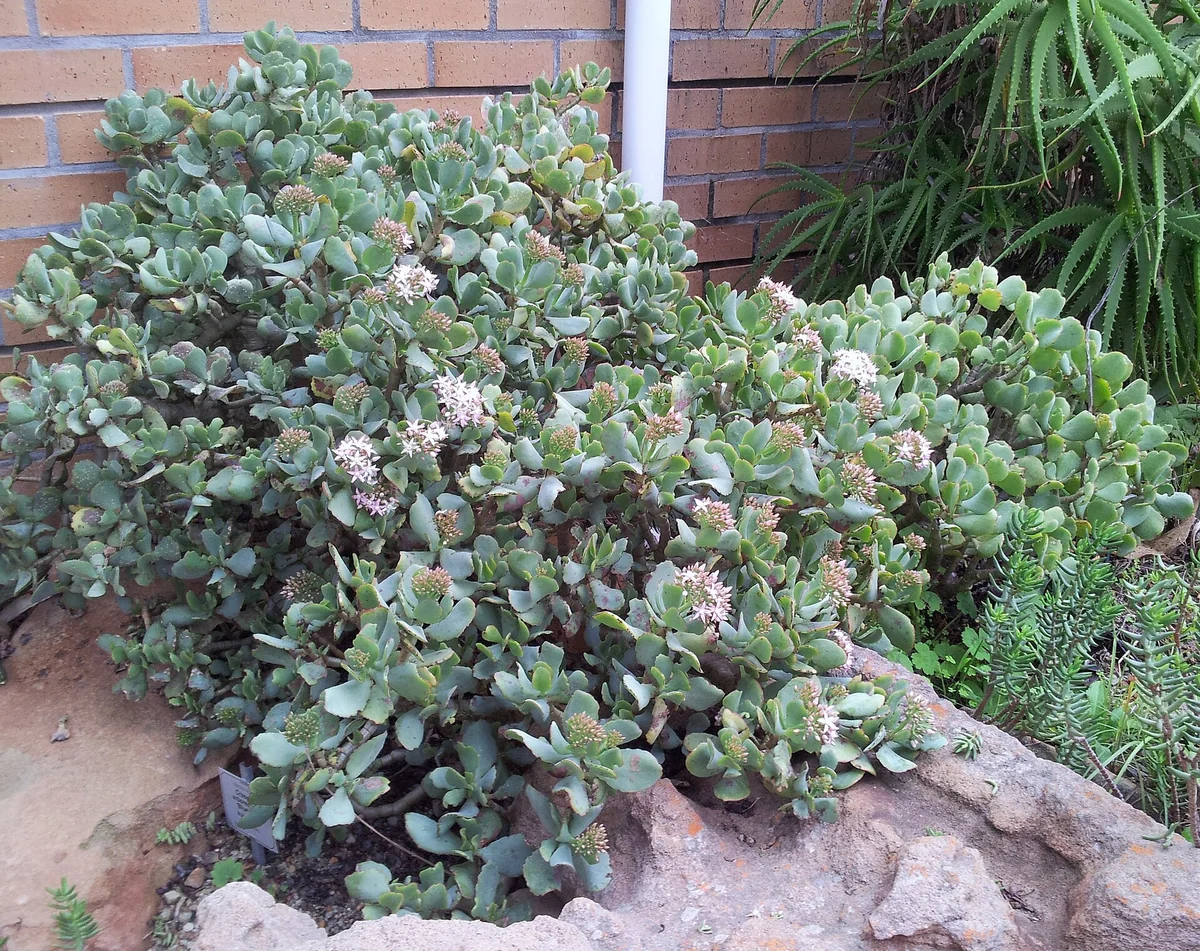
A silver leaved tree in succulent form
Silver jade tree offers something different from the glossy green jade often seen on sunny windowsills. Crassula arborescens carries rounded blue grey leaves with a natural waxy surface, sometimes edged with red, above a thick succulent framework. Its tree like habit is real, but the appearance of a mature small tree develops over time. A young plant may initially be a few upright stems rather than an instant sculptural specimen. Choose it for a bright room where that growth can be supported, not for a dim office corner where the silver foliage would merely look attractive for a short display.
The species comes from southern Africa and can grow as a large shrub or small tree in suitable natural conditions. Its name refers to that woody looking habit. There are recognised forms with differing leaf shapes, including an undulating leaved form, so preserve a more precise nursery label when available. It is distinct from Crassula ovata, even though both are commonly placed under jade names in retail displays. Do not transfer every care claim, toxicity statement or cultural story from another jade without checking the identity. The visible rounded leaves and their powdery surface are useful identification features rather than decorative dirt.
Keep the silver canopy in useful light
Give the plant very bright light with sun introduced progressively if it has been raised under shade. Firm compact growth is more achievable close to a suitable window than several metres behind it. A south or west facing site may be useful in some homes, but assess the real heat and shading rather than relying only on direction. Sudden fierce exposure can damage leaves that formed in subdued conditions. Leave enough room that the broad succulent foliage is not repeatedly brushed by a curtain or a person passing. Marks on the waxy surface can remain visible after the contact has stopped.
Do not polish or repeatedly wipe the leaves to make them shine. Their pale coating is part of the plant's natural appearance, and rubbing it can leave irregular marks. Dust can be handled gently when necessary without treating the surface like a piece of furniture. If the tree spends a suitable summer outdoors, acclimate it carefully and protect it from cold and prolonged saturation. It should return to bright frost free accommodation when required by the climate. An airy well lit room usually offers a more workable winter situation than a dark humid enclosure chosen merely because it feels warm to a person.
Let the roots dry between useful drinks
Use a gritty open succulent mix in a pot with unobstructed drainage. The container should stabilise the thickening framework without leaving excessive unused damp material around a small root system. Keep the stem base at its previous depth and avoid burying lower leaves. A decorative outer planter should be easy to empty after watering. Silver jade's leaves store water, so a routine designed for a constantly moist tropical foliage plant can be inappropriate. Drainage depends on the entire medium and the outlet holes, not on a decorative gravel layer added above a dense saturated root ball.
Check the occupied root zone and water thoroughly after sufficient drying, then allow runoff to leave. Learn the pot's weight instead of judging moisture from the pale foliage colour. A cool or dim season often extends the interval considerably. A warm actively growing specimen in a small pot can still need timely replenishment. Shrivelling, softening and fallen leaves should be considered with the actual root conditions. A plant can lose firmness above either a dry root ball or failing wet roots, so another drink is not a universal answer. Avoid changing fertilizer before the moisture pattern has been understood.
Build the branches without breaking them
Prune selectively when conditions support recovery, preserving enough useful leaves and the branch arrangement that the tree needs. Succulent stems can break under force, and mature sections should not be bent as though they were a flexible woody bonsai wire exercise. A young upright specimen can be encouraged toward a balanced framework through measured cuts rather than by removing most of its foliage at once. Leave space for light within the crown. If one side grows strongly toward the window, address the exposure and carefully rotate the pot before repeatedly cutting away the same side to disguise the underlying imbalance.
Repot in response to root development and the condition of the mix, not simply because the plant has a thick trunk. A large top and a relatively modest root system can be normal for a succulent, though the pot must remain stable. Use clean tools for any necessary root or branch work and keep fresh wounds out of persistently wet material. Suitable cuttings may provide new plants after the cut surfaces settle, but a fresh cutting must establish roots before it is treated like a mature tree. Modest nutrition during active growth is enough; concentrated feeding cannot create an old trunk on demand.
A flowering tree need not flower every year indoors
Clusters of pale star shaped flowers can appear on established silver jade plants in suitable seasonal conditions. They are an additional feature rather than a reliable annual requirement for a small indoor specimen. Do not respond to an absence of flowers with repeated high strength bloom treatments. Inspect leaf bases and sheltered branch areas for pests, including mealybugs, while keeping the waxy leaf surface intact as far as possible. A dark soft stem base requires attention to the roots and moisture. A firm old mark on a leaf has a different significance and may simply record earlier handling or exposure.
As a personal design choice, the blue grey leaves and stout framework can suggest balance, maturity or a sculptural connection to dry landscapes. Those descriptions concern appearance; they are not a promise of money, healing or improved air quality. A silver jade can suit an anniversary or new home gift for someone with a sunny growing position and an interest in succulents. It is a poor choice for a recipient whose only available space is shaded, even if their home has exactly the interior colour scheme that suits the leaves. Living conditions must come before the decorative match.
Protect the identity and the natural finish
Give the recipient the complete botanical name and any named form, together with the current substrate and recent care history. Choose a stable pot that permits drainage and can still be checked without dismantling a display. Keep ornamental plants out of unsupervised tasting and do not attach edible uses from another species to this one. Through the first growing cycle, judge success by firm new leaves and a manageable branch structure in suitable light. Allowing the natural powdery finish and gradual growth to remain visible is more rewarding than trying to produce a permanently polished showroom object.