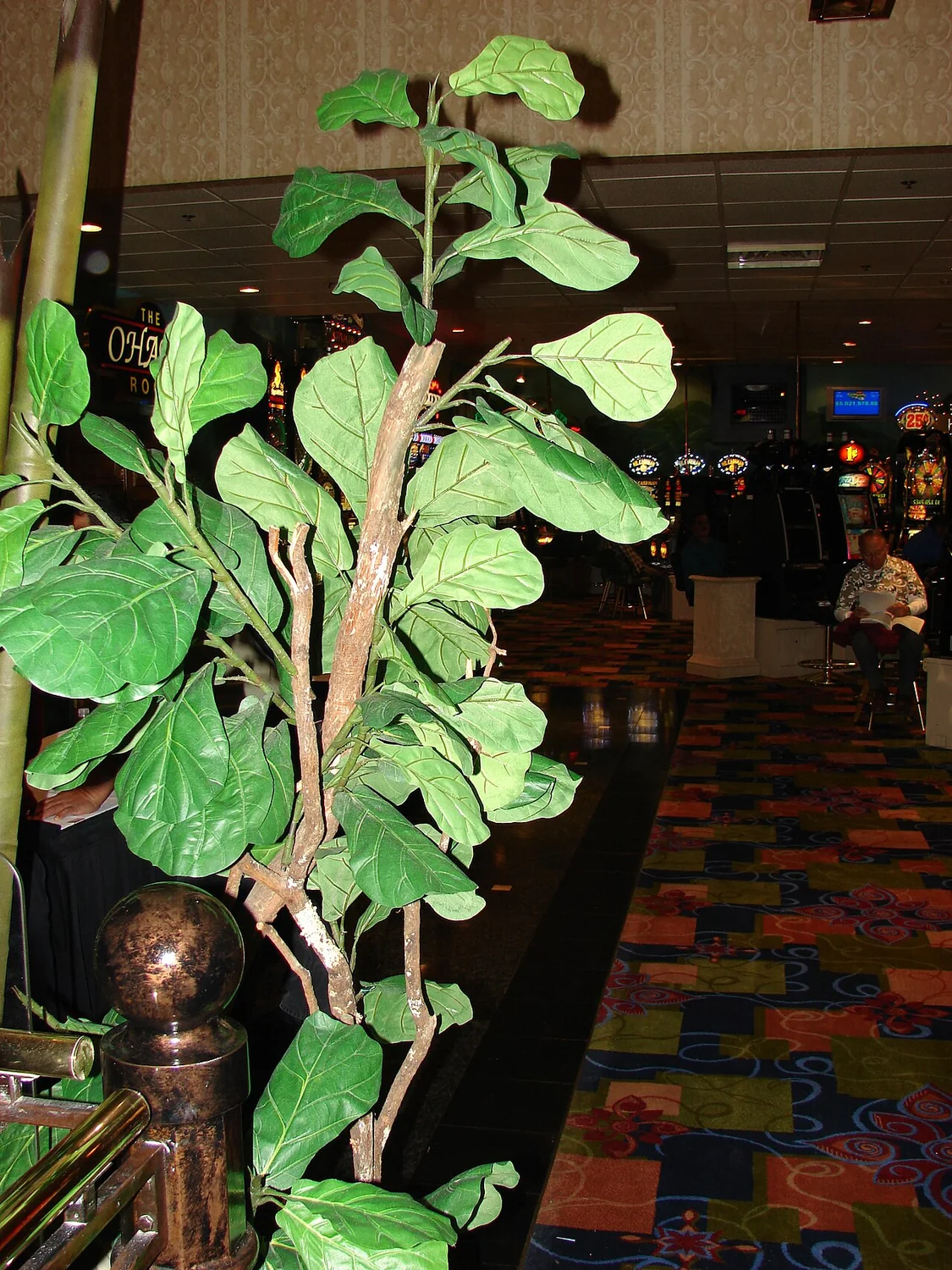
The forest tree behind a familiar silhouette
The distinctive leaf of Ficus lyrata widens toward its outer end and narrows around the middle, giving the fiddle leaf fig its familiar musical name. Those broad blades create a bold crown above a relatively small trunk, which explains both its decorative appeal and the practical space it needs. The species originates in the wet tropical regions of western and central Africa, where it can develop into a large forest tree. Indoor cultivation is an exercise in sustaining a manageable juvenile under much lower light. A bare stem topped by several enormous leaves is not a naturally compact houseplant architecture that will remain unchanged forever.
Start with the window before choosing the pot colour. A fiddle leaf fig needs strong useful daylight near its foliage, although sudden unaccustomed afternoon sun can damage leaves formed in a shaded nursery. A bright east exposure or a sheltered position near a large sunny window can work when the actual light reaching the crown is assessed. A plant set several metres back merely to complete a room arrangement may slowly lose its lower leaves. If one side faces glass and the other a wall, make modest periodic turns to keep the framework balanced. Never expect a brighter ceiling lamp to have the same effect as a suitable growing light.
Light and a workable indoor position
The transition into a new home is often more significant than a particular feeding product. Keep the tree away from an air conditioning outlet, a winter radiator, and the line of a door that admits cold air. Several environmental changes imposed together make later symptoms difficult to interpret. Establish a workable position and monitor it rather than moving the tree every time a leaf looks imperfect. Its large leaves can be torn by traffic, a moving curtain, or rough handling. An old tear remains visible, but new damage can be prevented by allowing clearance around the crown. This is especially relevant in busy reception areas.
Water, roots, and a draining container
Check moisture below the surface before watering. The upper mix may look dry while a large lower root zone remains damp, particularly inside a tall decorative planter. When the plant needs water, moisten the full ball slowly until some drains from the base, then empty the cover or saucer. Avoid leaving the nursery pot standing in the drained water. A partly shaded winter tree generally uses water more slowly than an actively growing tree in summer light. Complete collapse followed by a prolonged soaking is an unstable routine for roots and leaves. A probe and a record of pot weight can make the drying pattern easier to understand.
Choose the root environment to match the actual roots, not the height of the leaves. A disproportionately large pot holds moisture in areas the root system has not yet occupied. A moderate increase in size, an airy indoor container mix, and unobstructed drainage are more manageable. Repot when crowded roots and repeated rapid drying justify the disturbance. Support the existing ball as it is removed and keep the trunk at its previous planting depth. If the desired floor planter is much larger, retain the plant in a correctly sized inner pot and use a stable raised support, while ensuring that the empty space cannot become a hidden reservoir.
Training and ongoing maintenance
Wipe the broad foliage carefully when dust becomes visible. Support each leaf from below and use water on a soft cloth, keeping pressure gentle around the raised veins. New leaves unfold gradually and should not be pulled apart to accelerate the process. Plain cleaning also provides an opportunity to notice scale, fine webbing, or small cottony deposits near a vein. A glossy coating can conceal the surface and is not necessary for the naturally textured leaf. Keep fallen leaf pieces and discarded growth sheaths off the mix. The aim is an observable plant, rather than a polished display that hides its condition.
Branching requires a decision about future form. A single stem can be shortened above a living node to encourage a different framework, but the response is not instant and depends on the plant having enough light and reserves. Avoid a major cut while roots are struggling or a recently delivered tree is still adjusting. Gloves and protected flooring are appropriate because fig latex may irritate skin and stain surfaces. A small leaning stem can be loosely supported while the location is improved. Severely tying the trunk upright without correcting a one sided light source simply transfers the problem to the next extension of growth.
Spots should be interpreted by their distribution and timing. Crisp pale patches that appeared after a sunny move suggest a different cause from dark soft areas appearing while the root ball stays wet. Tiny reddish marks on expanding leaves can have several causes and should be observed alongside watering fluctuations rather than immediately treated as a pest. Repeated leaf loss, damaged new growth, or a soft stem warrants closer inspection. Feed at the labelled indoor rate during active growth and pause when conditions do not support growth. Adding nutrients to damaged roots does not correct their lack of air or a poor temperature regime.
Meaning without unsupported promises
The fiddle leaf fig has a strong place in contemporary interior design, but that visibility should not be confused with a universal cultural tradition. For a personal gift, its broad canopy can stand for confidence, creative expansion, or the beginning of a larger undertaking. State such symbolism as the giver's interpretation. The species is not interchangeable with the sacred fig or banyan merely because all are figs. Its botanical story is already interesting: a tropical forest tree has been adapted to life beside a window, and its shape asks the owner to consider light, scale, and continuing change rather than a static decorative object.
A gift matched to the recipient
A suitable gifting occasion is a move into a brighter long term home, a studio opening, or a celebration for someone who has specifically wanted this tree. It is a less considerate surprise for a recipient with limited floor space or no reliable access to a window. Discuss pets that chew foliage and children who might pull on a top heavy pot, since fig sap and leaves are not suitable play materials. A young stable specimen can be easier to establish than a very tall transported tree. Include its correct name, explain the recent watering state, and allow the owner to choose the permanent location before the plant arrives.