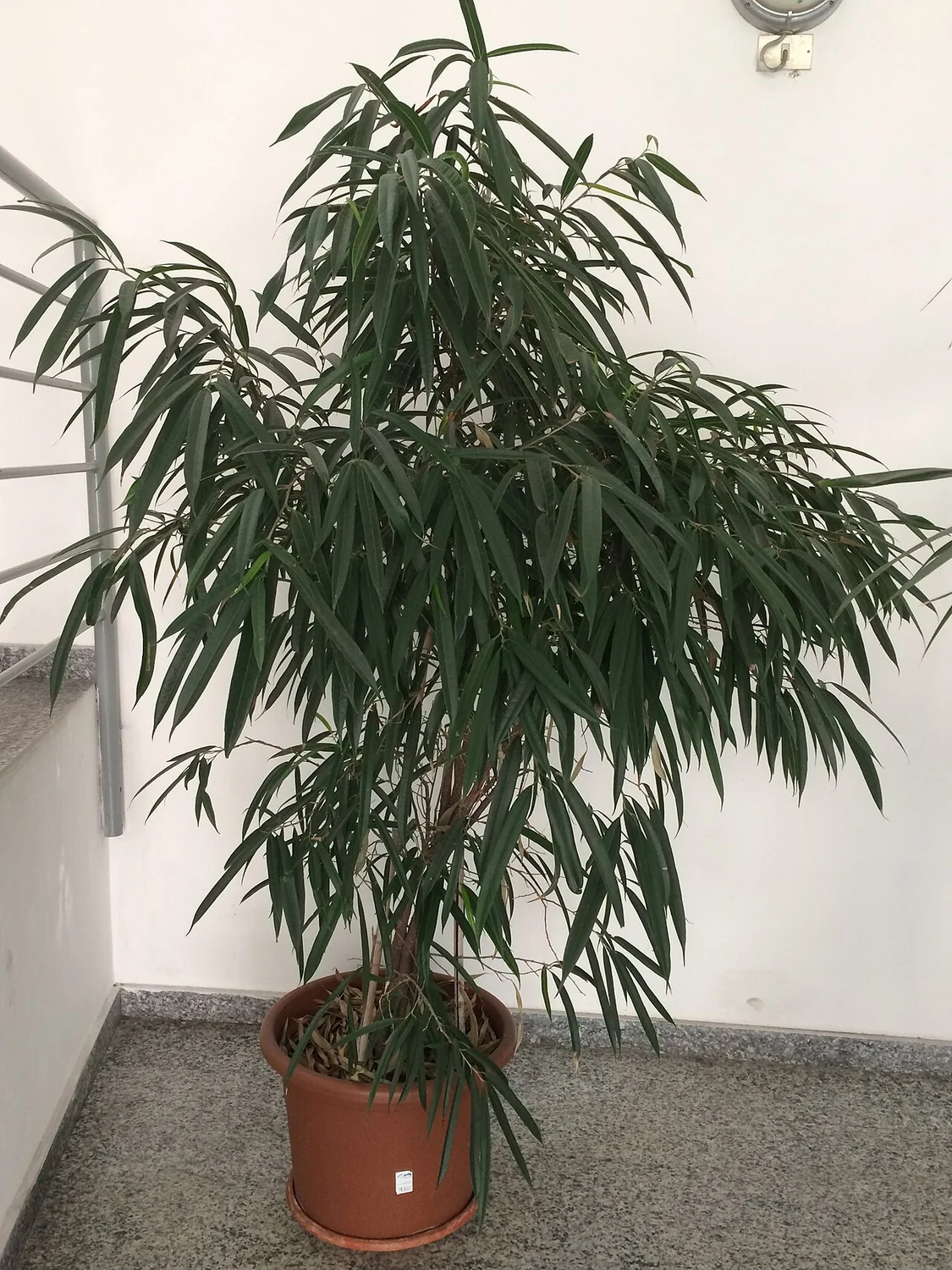
The narrow foliage of banana leaf fig
Banana leaf fig gives an indoor tree the texture of long narrow ribbons rather than a collection of broad paddles. Its hanging leaves help explain why Ficus maclellandii, particularly the selection sold as Alii, is used where a room needs height without the heavy visual mass of a rubber tree. The species comes from parts of southern and southeastern Asia. Nursery names are not completely uniform, and older labels may use related narrow leaf fig names, so retain the supplier's botanical information. A tree with multiple stems is often a nursery arrangement. It does not follow that every stem will remain equally vigorous as the canopy expands.
Allow space for the leaves to hang naturally from the ends of flexible branches. A narrow passage may appear wide enough for the pot while catching the canopy every time a coat or bag passes. Choose a position slightly away from the main walking line, with the brightest side directed toward an open window. Inspect the plant from its intended viewing height before committing to a tall stand. A specimen that looks airy on a nursery floor can become top heavy when elevated. An ordinary stable floor pot is often the more useful arrangement for a tree that may eventually approach room height.
Light and a workable indoor position
Bright indirect light supports a fuller crown and shorter spaces between the newest leaves. An east facing window or a well lit position near a larger exposure can provide that light, with afternoon shelter where glass becomes hot. If direct sun is part of the intended location, introduce it after the plant has settled rather than moving a shaded specimen straight into the strongest beam. This species is sometimes described as forgiving, but a dark office still limits growth. A thinning interior and shoots extending only toward the window are observable reasons to improve the location, not evidence that a special leaf product is missing.
Water, roots, and a draining container
The narrow blades can give the impression of a plant that needs little water, yet the root ball must be checked rather than judged from leaf shape. Allow the top portion of the mix to dry before another thorough watering. In a substantial pot that may mean probing a few centimetres down, while a small nursery specimen requires a shallower check. Water across the root area until it drains, then remove the surplus from the outer cover. When new shoots are extending strongly, water use can increase. After a major pruning or a period of reduced daylight, the same roots may stay moist considerably longer.
Keep a manageable relationship between pot size and canopy size. A container only a little wider than a crowded root ball usually provides a more predictable drying cycle than a very large planter filled mainly with unused compost. Repot when roots have occupied the available mix, drainage is difficult, or the plant repeatedly dries too quickly for its setting. Use an open houseplant medium and retain the established level of the trunk. Do not hide a declining stem by banking extra compost around it. If a cover pot is used, ensure that its base can be inspected without tipping the entire tree and damaging the leaves.
Training and ongoing maintenance
Training a banana leaf fig is best approached branch by branch. Decide which stems form the permanent outline, then shorten selected extensions above useful leafy nodes. Cutting everything to an identical height removes the relaxed appearance that distinguishes the plant. A young leaning trunk can be loosely supported while lighting is corrected, but a tight permanent tie may mark the bark. Cut stems release latex, so protect hands and nearby surfaces. Check whether a braided or grouped retail specimen has concealed bands around the base. Nursery presentation should never prevent the thickening stems from being inspected and cared for separately.
Dust can collect along the narrow blades even when it is less obvious than on larger figs. Support a small group of leaves and clean gently with a damp cloth, or rinse a manageable tree where water can drain without flooding the root zone. During cleaning, look for fixed scale insects along stems, whitefly movement, and pale or cottony deposits in protected leaf junctions. Investigate a repeated pest pattern before choosing a treatment. An occasional old leaf dropping from a growing crown is less concerning than many leaves yellowing over continuously wet mix. Keep fallen material off the pot surface so the stem bases remain visible.
Moderate feeding suits a tree maintained under indoor light. Apply a suitable product according to its instructions while growth is active, taking account of any fertilizer already present in the potting mix. Do not copy the feeding schedule used for a tree growing outdoors in tropical sunshine. Consistently cold drafts, a badly shaded canopy, or saturated roots cannot be repaired by providing more nutrients. In winter, let the pace of growth guide a quieter routine. Before moving the tree outside for summer, compare night temperatures and gradually increase exposure, then bring it back before cold conditions make the return transition abrupt.
Meaning without unsupported promises
Alii is a horticultural selection name that may appear in the trade; it should not be used as a shortcut to an invented royal history for an individual plant. The narrow foliage can instead support a straightforward personal interpretation of grace, flexibility, or a quieter style of growth. A design minded recipient may enjoy the contrast between a firm woody trunk and leaves that move with the air. Describe that symbolism as a chosen message, not an established guarantee of luck. The botanical origin and the nursery work involved in developing an attractive indoor framework provide a substantial story without adding an unsupported legend.
A gift matched to the recipient
A banana leaf fig can mark a move into a home with tall bright windows, the opening of a calm reception space, or a milestone for someone who enjoys shaping woody plants. Confirm the recipient's ceiling height and ability to reach the crown before choosing a mature specimen. It is not an ideal surprise for a dark desk or an owner who cannot lift the inner pot to check drainage. Fig latex and foliage should remain inaccessible to chewing pets and curious children. A smaller balanced plant with a clear identity often makes a more generous long term gift than a dramatic tree that immediately needs relocation or drastic pruning.