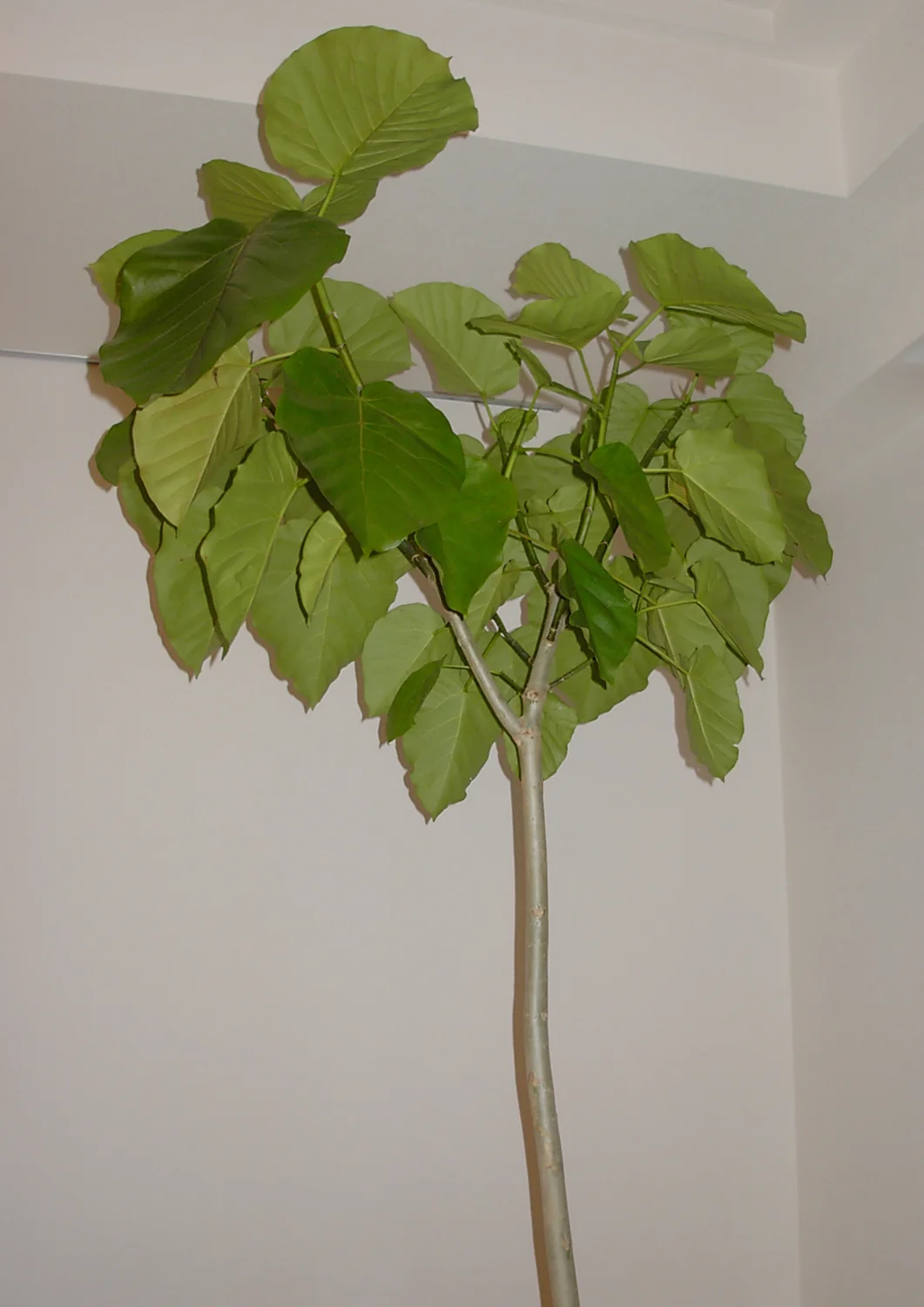
Heart shaped leaves and African origins
Umbrella fig is chosen for the sweep of its large heart shaped leaves, which spread from long stalks and give a young tree an unusually open, expressive crown. Ficus umbellata is native to tropical Africa, with a range extending across parts of western and central Africa toward Ethiopia and Angola. Kew places it in the wet tropical biome, an origin that helps explain why it should be treated as a warm growing foliage tree. The name umbrella fig describes the impression of the canopy; it does not identify a schefflera or guarantee that the plant will form an evenly rounded umbrella without training.
The leaf size deserves practical planning. A relatively short specimen can occupy more usable width than a taller narrow leaf fig, especially when the long petioles extend toward a window. Place it where nobody must brush past the blades to reach a chair or cupboard. A low pot beside a bright seating area can display the leaves more naturally than a high stand squeezed beneath a ceiling. When purchasing, examine the stem and the newest leaf as well as the largest existing blade. A dramatic old leaf is less useful than a plant that can continue producing sound new growth after it comes home.
Light and a workable indoor position
Strong filtered daylight is a useful baseline for indoor culture. The tree should be close enough to a substantial window for its entire crown to receive light, rather than positioned deep inside the room because the silhouette looks pleasing there. Introduce direct sun cautiously if the stock has been grown under shade. Large leaves can expose a broad area to a sudden hot beam and retain the resulting pale damaged patches. A sheer curtain may soften severe afternoon exposure without requiring the tree to be moved into darkness. Observe whether the newest leaf develops a useful size and whether the spaces between leaves remain reasonably compact.
Water, roots, and a draining container
Moisture management should be deliberate rather than based on the size of the leaves alone. Check the upper root zone and the weight of the pot, then water the full ball when it has dried sufficiently to need another drink. Let surplus water leave the base and empty the cover. A leaf drooping over wet compost requires a different response from the same leaf above a dry light pot. Avoid flooding the roots in an attempt to compensate for low room humidity. The tree needs both usable moisture and air around its roots, and one cannot replace the other.
A modestly sized inner pot with drainage is easier to manage than a large ornamental vessel filled directly with dense compost. Use a stable open container mix and keep the trunk at its existing depth during repotting. Inspect older roots when the plant has filled its container or repeatedly dries too rapidly for reasonable care. If new mix is added around a dense nursery ball, check that water penetrates both regions. Some runs straight through loose new material while the original ball remains comparatively dry. Leave room below the rim for slow watering and choose a base wide enough to support the spreading canopy.
Training and ongoing maintenance
Warmth and consistency help make the leaves easier to interpret. Keep the plant clear of cold window panes, a door used throughout winter, and concentrated air from a cooling system. An office that shuts its heating off overnight may not offer the same environment as a continuously occupied home. If the room air is very dry, consider a suitable humidifier rather than repeatedly spraying the leaves and leaving wet patches on furnishings. A light occasional cleaning with a damp cloth removes dust without adding an artificial shine. Support the blade while wiping, because a crease or broken petiole cannot be repaired afterward.
Pruning changes the distribution of a small number of visually important leaves, so plan each cut carefully. Shortening the main stem above a live node may encourage a different crown, but removing the top of a weak plant is not a reliable cure for poor growth. Wait until the tree is established and has enough light to rebuild. Gloves are useful because fig latex can irritate skin, and cut material should be kept away from pets and children. A loose support can protect a young trunk while it strengthens. The tie should stabilize the stem without pulling it into an unnaturally rigid line.
Check the broad leaf undersides for mites, scale, and mealybugs, particularly after a plant has spent time in a crowded nursery or mixed collection. Fine speckling and webbing need inspection rather than an automatic fertilizer increase. Feed only while active growth and adequate light support the process, using the instructions for an indoor product. Repeated brown margins may involve drying roots, salts, or exposure, so investigate the sequence of watering and recent changes. Photographs taken from the same angle can document whether the canopy is developing, but they should complement hands on checks rather than replace examination of the pot and stem base.
Meaning without unsupported promises
Its heart shaped foliage offers an obvious opportunity for personal symbolism, such as affection, welcome, or the desire to make a room more generous. That is a chosen design interpretation, not evidence of a specific historical gift tradition for Ficus umbellata. The African origin of the species should be described accurately without turning an entire continent's diverse cultures into one invented story. A recipient interested in botany may appreciate the tree's relationship to other figs and the way a forest species has entered indoor cultivation. It is unnecessary to promise good fortune or cleaner air to make that botanical story engaging.
A gift matched to the recipient
This fig can suit an anniversary, a housewarming, or a new creative workspace when the recipient has explicitly welcomed a broad foliage tree. Confirm that the room has adequate light and the owner can reach the pot for thorough watering. It is a less suitable surprise for a narrow shared office, a home with frequent cold drafts, or a pet that investigates every fallen leaf. Choose a stable plant of manageable size and include its botanical label. A note explaining the personal meaning of the heart shaped leaves can make the gift specific, while honest information about space and continuing care respects the recipient's actual circumstances.