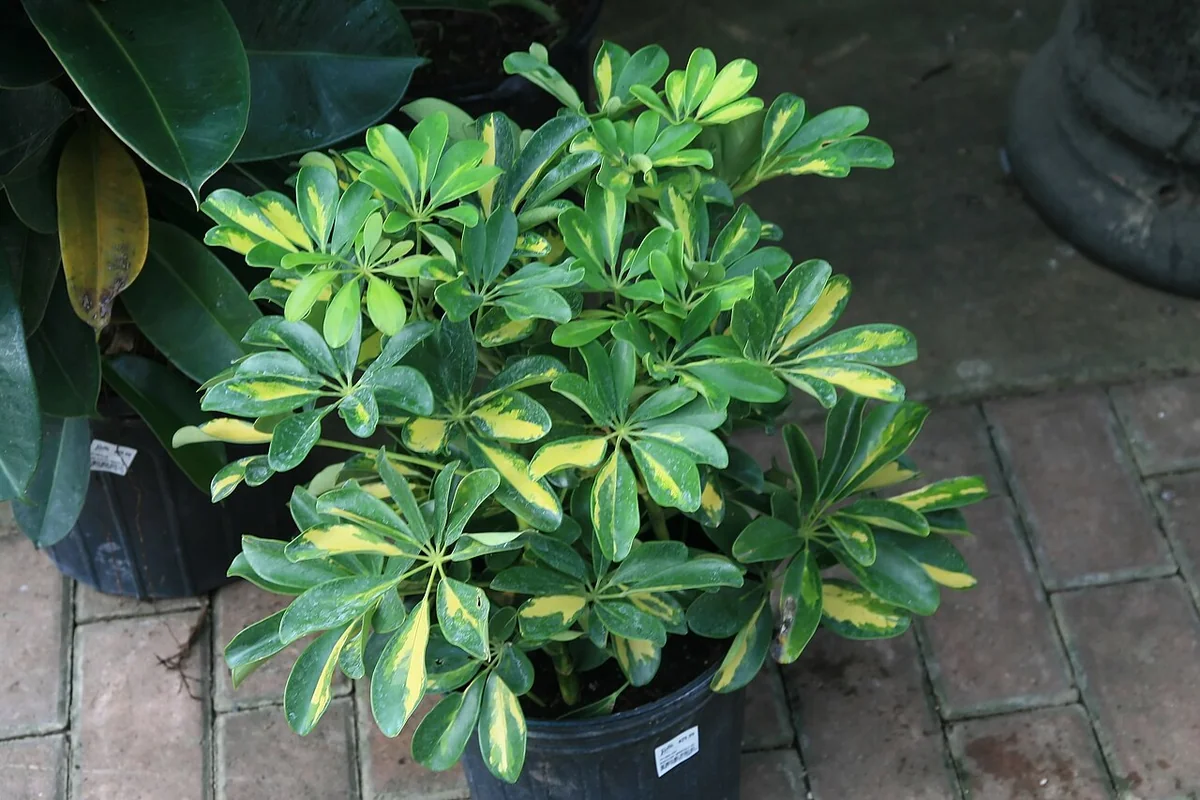
Recognizing the dwarf umbrella tree
Dwarf umbrella tree makes a compact woody framework from leaves divided into several glossy leaflets, each cluster opening like the ribs of a small umbrella. It is widely sold under the older name Schefflera arboricola, while Heptapleurum arboricola is the accepted name used in current botanical references. The species is associated with Taiwan and Hainan in its native range. In cultivation it can become a broad shrub or small tree, and the word dwarf is relative to larger umbrella trees rather than a guarantee of a permanently small desktop plant. Several stems in one nursery pot are often used to create an immediate impression of fullness.
Leaf colour and growth habit deserve attention when selecting a plant. Variegated forms can have cream or yellow areas, and their appearance depends on maintaining enough useful light for the green parts to sustain growth. A compact green selection may be more forgiving of moderate indoor conditions, but neither belongs in a windowless corner simply because it is often described as an office plant. Examine the main stems and remove decorative sleeves long enough to see the base. A proportionate pot, intact leaflets, and clean leaf junctions offer a better start than a large canopy concealing tightly crowded or damaged roots.
Light and a workable indoor position
Choose bright indirect light, or an exposure with gentle direct sun after the plant has adjusted. The clustered leaves shade one another as the crown thickens, so arrange the pot where the inside of the framework can still receive daylight. A plant against a wall may gradually lose foliage on the hidden side. Small rotations can improve balance, provided they do not abruptly expose shaded foliage to a hot beam. Office use is realistic near a suitable window or a correctly specified growing light. Ordinary overhead illumination alone is a weaker basis for long term growth, especially as the tree becomes larger and the lower branches are farther from the fixtures.
Water, roots, and a draining container
Water after checking the upper mix and the condition deeper within the root ball. Allow some drying between thorough irrigations rather than keeping the pot constantly wet. When it needs water, wet the full root zone and let the excess leave the drainage holes. Empty the outer cover before returning the plant to its display position. A recently pruned tree has less leaf area and may use water more slowly, whereas a warm bright period can accelerate drying. Drooping leaflets can accompany either dry roots or damaged wet roots, so the leaves alone should not decide the response. Check the pot before taking the watering can.
Repot when roots and drying behaviour show that the container has become restrictive. A moderate increase in pot size with an open indoor mix usually provides a more controlled transition than moving directly into a large tub. Keep each stem at its established depth and do not use extra compost to conceal a weak or leaning base. A heavy cachepot can improve stability without changing the root volume, but it must not trap drained water. Inspect a grouped specimen stem by stem. One failing trunk in a crowded pot can be missed when its neighbours still look fresh, and the cause may remain hidden below decorative surface stones.
Training and ongoing maintenance
Pruning is useful for developing a small tree outline. A long shoot can be shortened above a living leaf junction to encourage branching, while selected lower shoots may be retained or removed according to the desired form. Avoid repeatedly clipping the whole crown into a dense shell that excludes light from the interior. Clean tools and protection from sap are sensible, particularly when a large amount of material is removed. A new owner should not begin with a major reduction immediately after delivery. Establish the plant first, then change its structure in stages so the response can be seen and the remaining leaf area stays adequate.
Wipe dust from the individual leaflets and check their undersides, the central point of each cluster, and the stems nearby. Scale and mealybugs often occupy protected positions, while mites may be easier to notice through fine speckling and webbing. Sticky residue on nearby furniture is a clue worth investigating rather than simply a cleaning nuisance. Warm stable room conditions are preferable to repeated drafts or a direct heater blast. Feed lightly during active extension, using the labelled rate and allowing for nutrients already in fresh compost. More fertilizer will not restore a shaded interior branch if light no longer reaches it.
The leaves contain irritating compounds, including calcium oxalate crystals, so this is not an edible household tree. Keep fallen leaflets and pruning material away from pets and children, and wash hands after handling sap. That practical point matters more than claims sometimes made about office plants improving wellbeing or cleaning an entire room's air. A healthy growing plant can be enjoyed visually without using it to make medical or environmental promises. If the recipient has an animal that repeatedly chews foliage, choose a different gift or a genuinely inaccessible location rather than relying on the fact that the canopy stands above floor level.
Meaning without unsupported promises
The umbrella form offers a straightforward personal symbolism of welcome, shelter, or a gathering of people, but those meanings should be presented as a design choice rather than a universal tradition. The naming history is also interesting: many familiar houseplants retain Schefflera on retail labels while botanical classification has placed Asian umbrella trees in Heptapleurum. A correct dual name helps a new owner connect older care references with current descriptions. There is no need to attach a story about guaranteed wealth or protection. A gift can acknowledge the tree's adaptable cultivated role and the thought that went into selecting a manageable specimen.
A gift matched to the recipient
This plant can suit a housewarming, a new shared studio, or an office welcome if the recipient has agreed to the space and care involved. A smaller branching plant is often easier to integrate than a tall tightly braided display. Check the room's winter temperature, the actual daylight at leaf level, and whether someone can inspect the pot while the owner travels. Variegated foliage should be chosen for a place bright enough to support it. Include both botanical names and explain that the watering interval changes with growth and light. A useful pot and an honest plan for the tree's eventual size make the occasion more thoughtful.