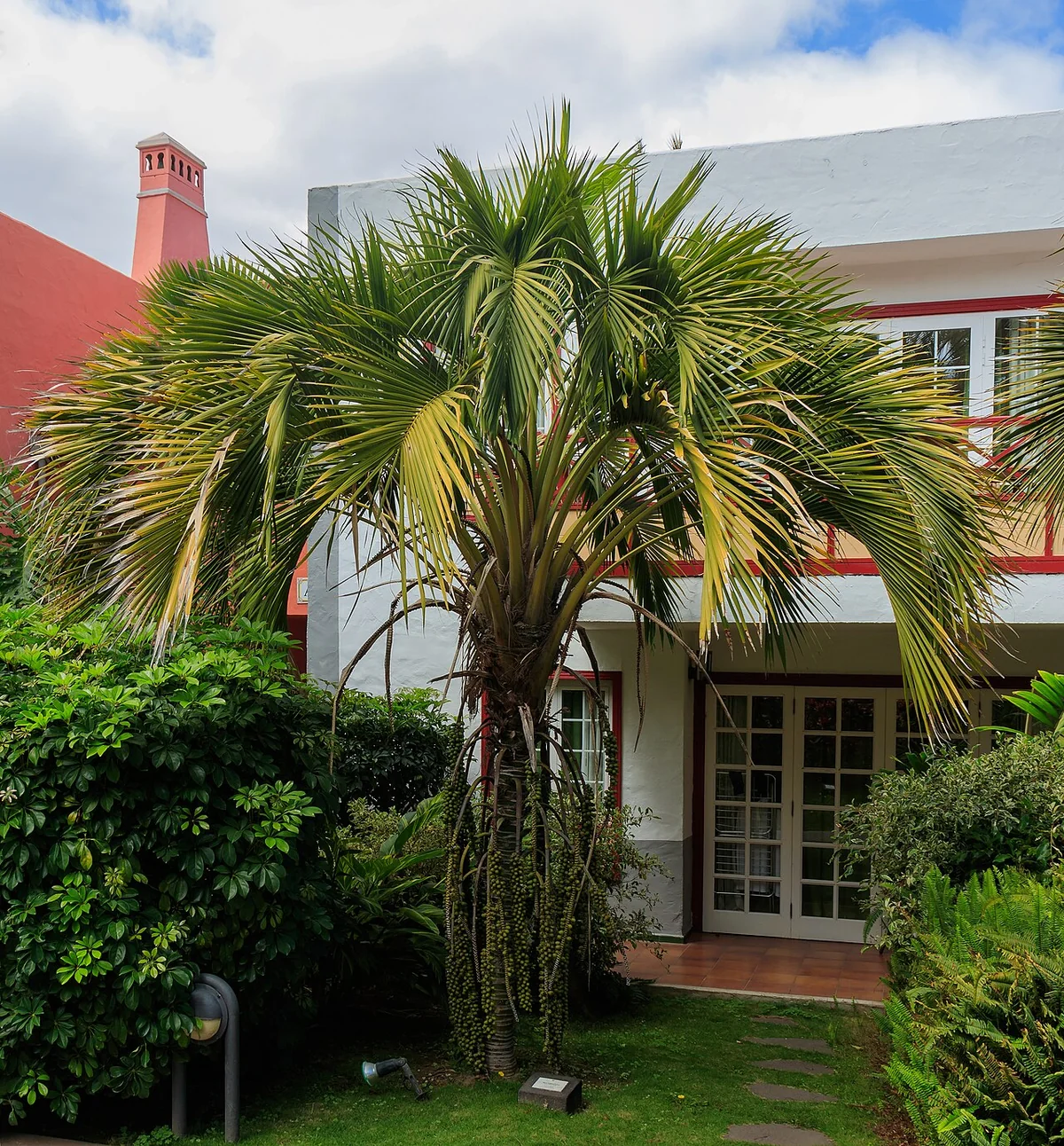
Recognizing the Sentry Palm
Howea belmoreana offers a more upright, strongly curved palm silhouette than the better known kentia. Its fronds rise and arch, with leaflets arranged along the central stem, giving an established plant a composed architectural outline. The name sentry palm suits that standing presence, but it should not lead to a narrow placement between furniture and a wall. The canopy still expands in three dimensions. A small young plant can be a long-term container subject; it is not a miniature that will hold exactly the same outline forever. Buy for the room available several years ahead, not only the space beside today's chair.
This palm is native to Lord Howe Island, as is its relative Howea forsteriana. The two should not be treated as different marketing names for the same plant. Belmoreana has a particularly pronounced curvature to its fronds, a feature that becomes easier to see as a seedling matures. Its species name commemorates a historical Earl of Belmore rather than describing a care requirement. Keeping that scientific label matters when comparing photographs or requesting advice. A mixed pot of juvenile palms can hide the eventual shape, so inspect each growing point and ask how the nursery has assembled the display.
A Protected Position for Curved Fronds
The best indoor starting place is bright, filtered light with a reasonably even temperature. A glass-sided office lounge may be suitable if direct hot sun is moderated and the pot is away from air-conditioning outlets. A low, shaded cubicle is not an equivalent habitat. The fine leaflets can yellow when exposure changes too sharply, especially on a plant brought straight from sheltered production. Introduce a new level of light slowly. Watch the position of the emerging frond and allow enough overhead clearance for it to extend before arching. A handsome location is useful only if growth can unfold there without obstruction.
Let the surface of the medium dry somewhat before a thorough watering, then allow the container to drain. The entire root ball should not remain parched for an extended period simply because this is a slow palm. Equally, a heavy pot that stays cool and wet should not be topped up on schedule. Water quality can contribute to leaf-tip discoloration, but changing water alone will not correct roots sitting in stagnant surplus. If local water and the palm's response suggest a problem, compare an appropriate alternative supply while keeping other conditions steady. Avoid diagnosing every brown edge from one suspected chemical.
Gentle Roots and Slow Renewal
Its roots deserve particularly gentle handling. Use an airy container mix and select a pot only modestly larger when the occupied root mass requires more space. Do not tease apart a settled seedling arrangement merely to make several gifts. Roots can be brittle, and separation may cost more growth than it gains. Support the root ball as it leaves the old container and keep the trunk bases at the same depth. A firm planting should come from sensible pot size and careful settling of the medium, not from pressing compost into a dense, poorly aerated mass around the stems.
Slow development changes the maintenance timetable. Repeated repotting, constant feeding, and weekly relocation do not turn belmoreana into a fast furniture-filling plant. They create more variables for a species whose response may take months to assess. Feed lightly during demonstrable growth using a suitable labelled product. In a cool, dim season, reduce inputs to match reduced activity. Marking the height of a new spear on a photograph can make progress visible without touching tender tissue. Closely spaced old leaf scars on a trunk are part of the palm's history, not evidence that its growth needs to be forced.
Keeping the Crown while Assessing Leaf Damage
Pruning must preserve the crown. Remove a fully spent lower frond with a clean cut that stays clear of living trunk tissue, and retain green portions whenever their appearance is acceptable. Never cut the upper growing point to create branching; a solitary palm cannot respond like a clipped hedge. Brown leaflet tips may be trimmed conservatively for appearance, leaving a tiny margin rather than repeatedly cutting into green tissue. Cleaning is easiest with gentle support under a section of frond. Dust removal should improve the leaf surface without bending the central stem against its natural curve or catching leaflets on jewellery.
Check the palm for scale and mites before introducing it into a settled plant group. The crowded bases of a multi-seedling pot can make early problems hard to see, while a backlit frond helps reveal uneven stippling. If a pest is found, identify it before applying a product and make sure the treatment is suitable for indoor foliage plants. A recently transported palm may also shed an older frond as it adjusts. That should be distinguished from a recurring deterioration of new foliage. Review watering at depth, exposure, and root disturbance when the pattern affects the whole plant rather than one ageing leaf.
Giving a Palm That Rewards Patience
The sentry palm is a good gift for someone who enjoys slow botanical change and has a protected bright floor position. Its upright posture can be used as a personal symbol of steadiness or attentiveness. There is no need to attach an invented ancient story or a promise of professional success to that interpretation. It is less considerate as an unexpected gift for a recipient who frequently changes apartments or has little transport space. Describe its curved fronds and sensitivity to unnecessary root handling in the accompanying note. A plant supplied with realistic expectations has a better beginning than a grand specimen delivered as a surprise burden.
Long-term success is easiest to judge by replacement: does the palm eventually produce sound new fronds while older ones retire at a reasonable pace? That is a more meaningful measure than demanding that every nursery leaf remain permanently pristine. Keep the pot reachable for drainage checks and retain an uncluttered area around the crown. If the canopy later becomes too large, relocating or rehoming the plant is more realistic than severe height reduction. The appeal of Howea belmoreana lies in the continuity of its form, supported by patient care that respects how a solitary palm actually grows.