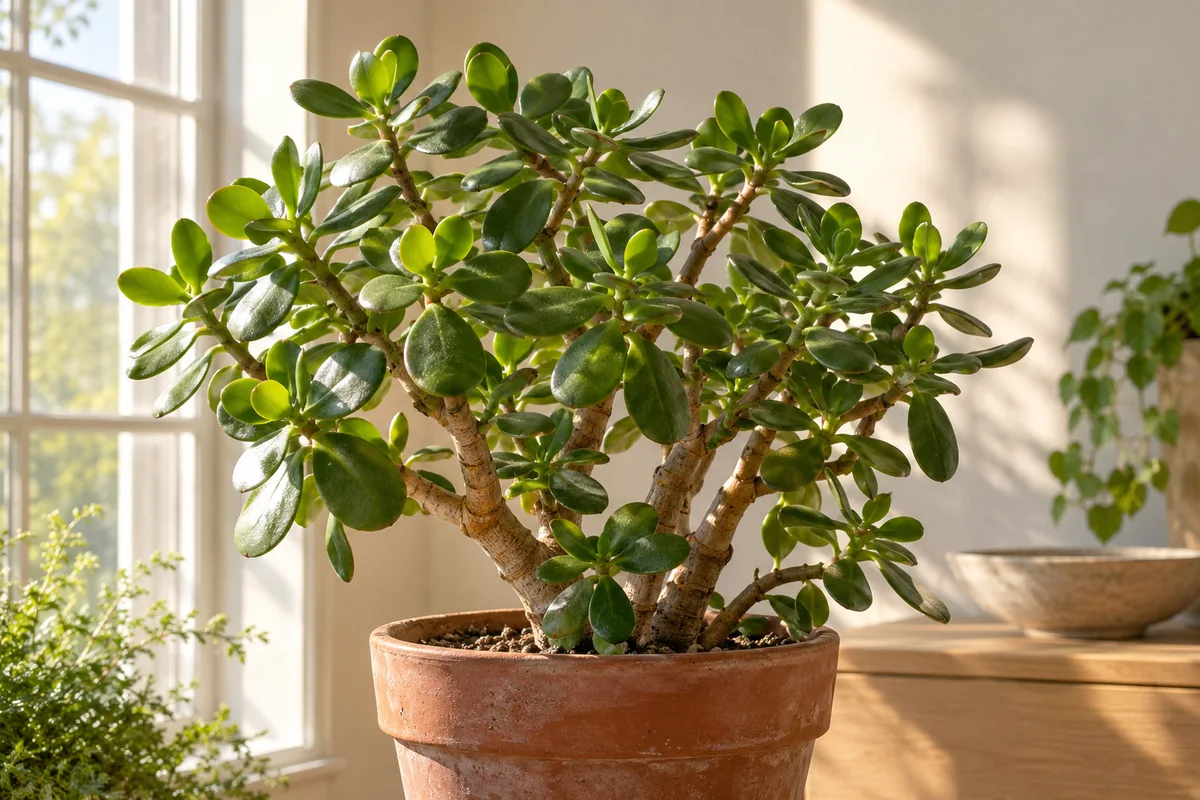
A jade plant should feel substantial for its size. Thick leaves sit close along sturdy stems, and an older trunk gradually takes on a branching tree shape. When the gaps between leaves become long and the stems lean, the plant is usually telling a story about its position. Brightness matters as much as watering for this succulent. A jade kept in a dim room cannot be made compact through careful pruning alone. Start by finding a bright window, then learn how long the roots take to dry there. That combination gives new growth a much better chance of holding the familiar dense shape.
Crassula ovata needs plenty of light indoors and can grow well with direct sun after gradual acclimation. A sunny south or west window may suit it in the Northern Hemisphere, depending on shading, season, and the heat near the glass. A plant moved suddenly from a dim shop to intense sun can develop bleached or dry patches. Introduce exposure in stages and check the newest leaves. Rotate the pot if growth leans consistently toward one side. Leave a little clearance from the window so foliage does not touch cold glass at night or become trapped against a very hot surface in the afternoon.
Let the root zone dry substantially before watering. A dry top layer is only part of the picture in a deep container, so check farther down with a wooden probe or learn the pot's dry weight. When water is needed, wet the mix evenly and allow the excess to drain completely. Empty the saucer or outer planter. Thick leaves can soften slightly as stored water is used, yet persistent softness combined with wet mix needs a root inspection rather than another drink. During a cool dim period, the interval between waterings can become much longer than it was during bright active growth.
A coarse succulent mix and a container with drainage make the root zone easier to manage. Some bagged succulent mixes contain a large amount of fine organic material, so examine the texture and adjust it with a suitable coarse mineral ingredient if necessary. An unglazed clay pot can help a small plant dry between waterings, while a heavier outer container may stabilize an older top heavy specimen. Keep any hidden reservoir empty. Repot only when roots have filled the available space or the pot becomes unstable. Increasing the diameter modestly avoids surrounding the roots with a large volume of damp material they cannot quickly use.
Shape a jade during active growth with a clear idea of where branches should develop. Cutting just above a leaf pair can encourage new shoots from nearby points, though the response depends on light and the condition of the plant. Remove a little at a time rather than stripping a mature specimen in one session. Clean tools help produce tidy cuts. The removed stem sections can become cuttings after their cut surfaces have dried appropriately, using a suitable propagation method and a small container. Avoid immediately burying a fresh thick cutting in saturated mix. Succulent tissue needs air around the base as roots begin developing.
Leaves are easily marked if the plant is squeezed or repeatedly knocked against a window frame. Move it by the pot, keeping fingers away from delicate branch junctions. Dust can be brushed away gently or wiped with a barely damp cloth while each leaf is supported. Do not apply oils to create shine. Some older leaves naturally dry and fall as branches mature. Remove fallen material from the surface so the mix remains visible. A sudden loss of many leaves calls for a review of moisture, light, and temperature. The exact pattern matters more than treating every dropped leaf as the same problem.
Use fertilizer sparingly while new stems and leaves are developing, following the chosen product directions and accounting for nutrients in recently added mix. Heavy feeding cannot replace direct light and can encourage soft growth when the position is unsuitable. A pale crust around the pot rim or on the mix may indicate accumulated minerals. Review the water supply and fertilizer rate, then flush a freely draining container when appropriate. Red coloring along leaf edges can occur under bright conditions in some plants, yet a rapid color change after a move deserves observation. Look for firm tissue and steady growth rather than judging a single color in isolation.
The most useful long term comparison is the newest stretch of stem. Closely spaced leaves and a firm upright branch suggest the conditions are supporting compact growth. Older stretched sections will not shorten after a move, so they may be pruned later once better growth is established. Keep watering tied to the root zone rather than a fixed weekday and give the plant a quieter routine when daylight weakens. A jade can remain in a modest pot for a considerable time. Plenty of light, a draining mix, and patient intervals between waterings allow its branching shape to become more distinctive as it matures.