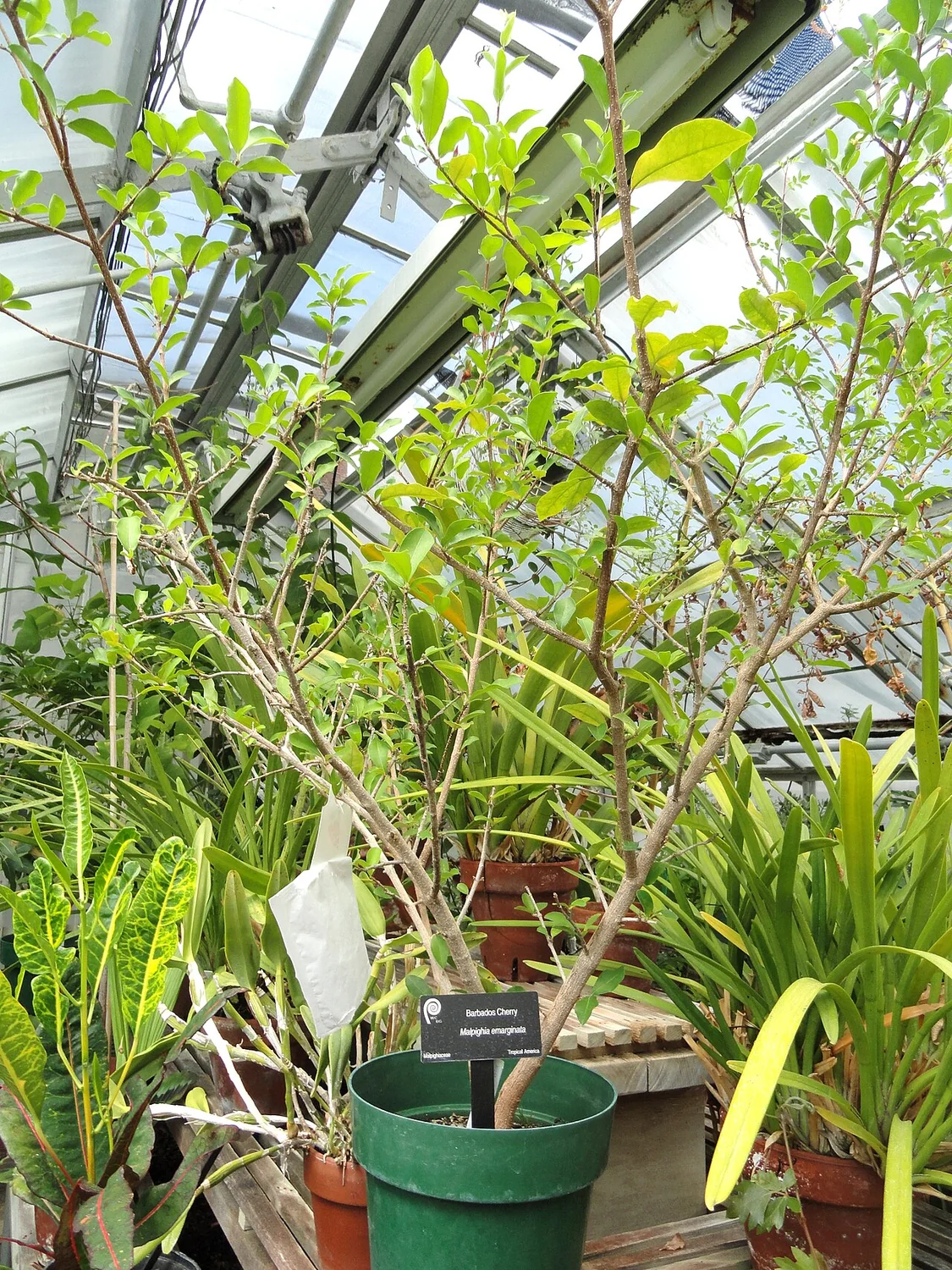
Acerola is a specialist small fruit tree
Acerola can appeal to a container grower through its fine woody framework, pink flowers and bright red fruit, but it is not a familiar temperate cherry reduced to fit a pot. Malpighia emarginata belongs to a different plant family and has tropical American origins. The common names Barbados cherry and West Indian cherry record cultivated associations rather than a cold hardy orchard habit. Its place indoors is a warm bright conservatory or a genuinely suitable growing room. An ordinary shaded office is unlikely to supply what a sustained fruiting project needs, regardless of how attractively the nursery has shaped the plant.
Older sources and retail labels may use Malpighia glabra or Malpighia punicifolia for acerola crops, so identity deserves attention. Ask the supplier which plant and selection they are actually offering. Cultivars can differ in growth and fruit character, and a compact selection is more useful in a constrained conservatory than an unknown vigorous seedling. The plant's reputation as a food crop does not justify medical claims or assumptions about the fruit on a decorative retail specimen. This guide concerns its cultivation and thoughtful placement. Any food use depends on accurate identity and an appropriate treatment history.
Give flowering growth real light
Provide a sunny warm position with the exposure introduced gradually if the plant has been held under shade. A conservatory should offer ventilation as well as brightness so the canopy is not trapped against overheated glass. Check whether the root pot receives excessive heat from the floor or a dark cover. A tree that fits neatly below a window may grow into a different light pattern as its shoots extend. If winter daylight is inadequate, supplementary lighting needs to reach the full useful crown. A ceiling lamp intended for the room's occupants cannot simply be assumed to replace that light.
Where summer weather is suitable, an outdoor season can help provide stronger growing conditions, but cold and wind remain relevant to a container plant. Acclimate the leaves and give the pot a stable sheltered position. Plan winter protection before the tree becomes difficult to move. Protect the crown from cold draughts and avoid direct hot air from a heater when it returns indoors. Fruit trees can be forgiving of some conditions in the ground because their roots have access to a wider soil volume. A small nursery pot does not offer that same buffer, so the protected routine must be based on observation.
Keep the active roots evenly supplied
Use a fertile open container mix with dependable drainage and enough moisture retention for a leafy growing tree. Preserve the previous collar depth and choose a pot proportionate to the roots. Increasing the volume dramatically can leave unused material wet while the original root ball behaves differently. Support a loose trunk only as needed and inspect any tie as growth thickens. A decorative outer container must be emptied after runoff has collected. The pot should remain accessible, because checking the roots is more informative than judging the tree's needs solely from the colour of a flower or the weight of an individual fruit.
Water thoroughly when the occupied root zone begins to need replenishment. Active growth and fruit development require more regular observation than a quiet winter canopy, but neither calls for permanent saturation. Test below the surface and learn the interval in the actual medium supplied. A dry nursery core may be missed by a small splash around the rim, while a wet lower layer can remain hidden beneath a dry top. If foliage wilts over damp material, examine root conditions and temperature before watering again. A useful crop depends on functioning roots, not on keeping the container as wet as possible.
Flowers, pruning and fruiting resources
Pink flowers are part of acerola's appeal even when indoor fruit set is limited. Cultivar, maturity and pollination affect the result, so avoid promising that one small retail tree will give a constant harvest. Retain enough leafy growth to support whatever crop develops. Prune for a balanced framework and safe access rather than repeatedly shearing every shoot into a rigid outer ball. A grower mainly interested in form may make different cuts from one hoping for flowers and fruit. Those aims should be understood before routine clipping removes the growth being awaited for the next display.
Feed useful active growth with a suitable container fertilizer at its instructed rate, allowing for nutrients in fresh medium. Acerola's nutritional reputation as a fruit has no bearing on whether its roots need concentrated fertilizer. More feed cannot replace insufficient light or resolve a waterlogged root ball. Examine the pattern of yellowing before adding separate supplements, and record applications where several people help with care. A manageable tree making firm new shoots is more useful than soft forced growth that immediately outgrows its position. Separate a major repotting from unnecessary heavy pruning so the plant's response remains easier to assess.
Keep the collection contained and observable
Inspect young shoots, leaf undersides and branch junctions for pests, especially before a summer specimen is returned near other indoor plants. Clear fallen debris and fruit from the root surface without disturbing fine roots repeatedly. Avoid treating every temporary leaf change as evidence of disease. Compare recent exposure, moisture and temperature, and look at how the rest of the canopy is behaving. If a fruit is being considered for food, confirm its nursery treatment and correct maturity separately. Ornamental cultivation should not become an invitation to taste unknown plant material or attach unverified health benefits to a living room tree.
Acerola can make a thoughtful present for a fruit collector who has specifically expressed interest in growing it under suitable protection. Its personal meaning might be curiosity about tropical crops or a connection with a familiar food, rather than a claim that the plant delivers vitality or good fortune. It is not an appropriate surprise for someone who has no warm sunny space and expects an almost independent office plant. Ask about the recipient's ability to move the container and maintain it during absences. A plant's botanical interest does not excuse passing on a growing task that the recipient cannot practically accommodate.
Preserve the crop's actual identity
Give the botanical and cultivar information, supplier details and recent care history with the tree. Mention the alternative names likely to appear in reference books so the recipient can compare guidance without assuming every similarly named cherry is the same plant. Choose a stable pot with usable drainage and an appropriate canopy size. The first year should establish light, roots and a seasonal routine before a heavy crop becomes the measure of success. An accurately identified acerola growing steadily in a suitable conservatory offers a more credible long term project than a heavily laden specimen temporarily displayed in a room that cannot sustain it.