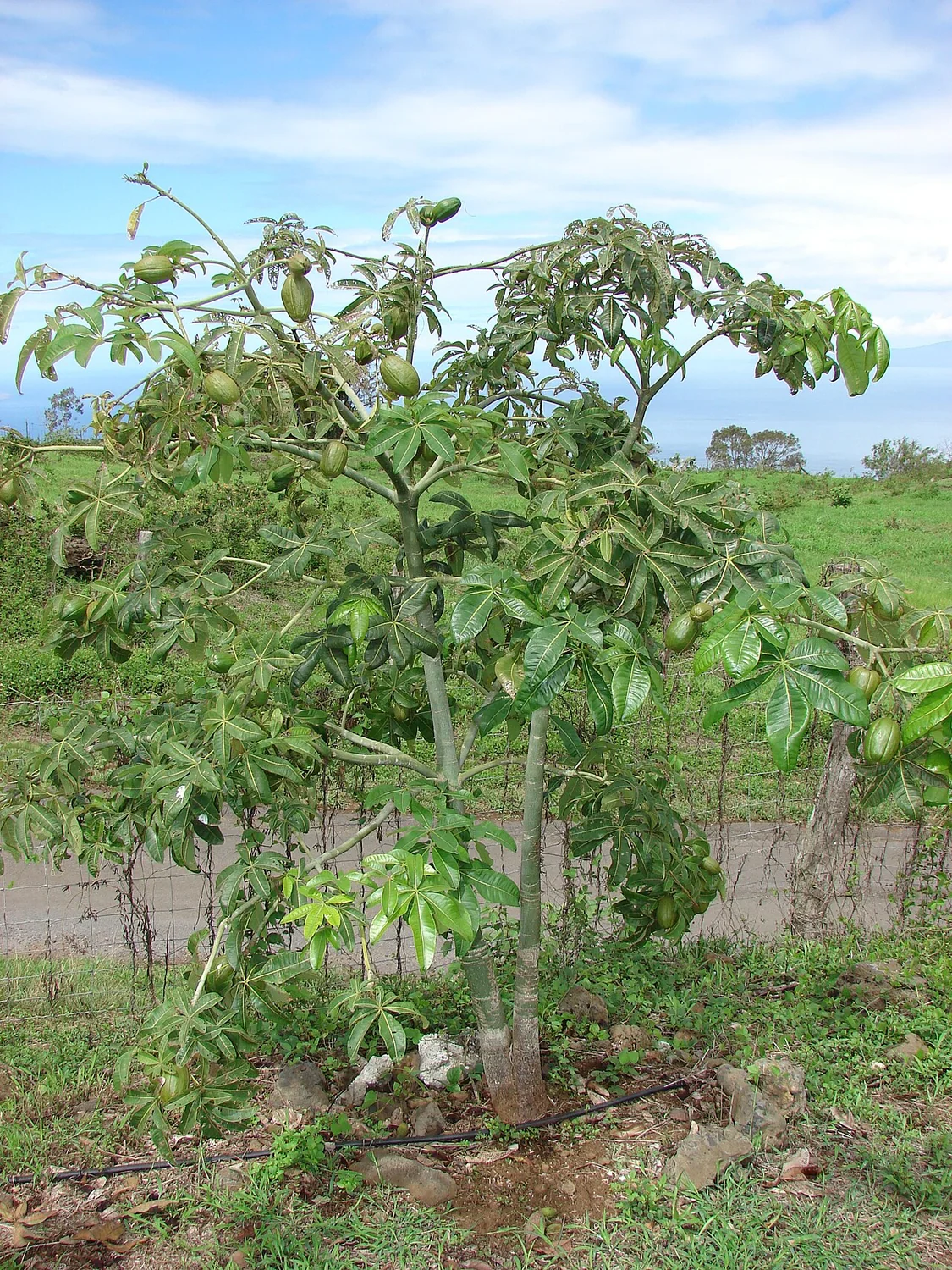
Separating smooth pachira from a retail label
Smooth pachira is an important tree to know because it can sit behind a familiar but inaccurate retail label. Pachira glabra is native to Brazil and is frequently encountered in the ornamental money tree trade, where its juvenile appearance can be confused with Pachira aquatica. Both can have hand shaped leaves and trained stems, so a braid or a leaf with several leaflets is not enough to establish the species. Keep identification conservative when flowers, fruit, or nursery provenance are unavailable. The tree remains an attractive indoor foliage subject, but accurate naming helps prevent the care and cultural account of one species from being copied unquestioningly to another.
In its native environment the plant is a substantial tree rather than a naturally miniature ornament. Small nursery stock may have a swollen lower stem and a narrow crown that later broadens. Look for a firm base and evenly distributed living growth when selecting one. A decorative container should not conceal soft stem tissue, a tight band, or roots that have been left in standing water. If several plants are grouped or braided, inspect them individually as far as possible. Their shared pot does not ensure that they all have the same root condition or that every stem will continue contributing equally to the crown.
Light and a workable indoor position
Bright filtered light supports an indoor plant more reliably than a remote shaded corner. Singapore's NParks records the species as a semishade subject, but that landscape description must be interpreted in relation to the much dimmer conditions found behind domestic walls and ceilings. Place it near a useful window and introduce stronger sun gradually if needed. Watch for new leaves maintaining their size and an even framework rather than a long thin extension toward the glass. A warm bright room is more suitable than a fashionable location that is cold overnight. Leaf appearance should be assessed alongside the growing environment, not as an independent decoration.
Water, roots, and a draining container
Water management depends on the container, not on the assumption that every money tree requires an identical drought routine. Inspect the mix and the weight of the pot, then moisten the root ball thoroughly when it has lost enough water to need replenishment. Allow the surplus to leave the base. NParks describes a high water preference in its growing context; that does not justify keeping an indoor root ball submerged in stale drainage water. Light, temperature, and the amount of foliage determine how quickly moisture is used. A small pot under active summer growth may need checking much more often than a large newly repotted specimen.
Use a medium that retains moisture while preserving air spaces, and choose a pot with functional drainage holes. If repotting is required, move up one sensible size and retain the existing depth of the lower stem. There is little benefit in hiding the plant in a large tub of dense wet compost simply to create a grander presentation. An outer cover can provide visual weight without increasing the root volume, provided it allows inspection and water removal. Observe whether the older nursery ball takes up water evenly after fresh mix is added. A dry central ball and wet surrounding material call for a different approach from uniform saturation.
Training and ongoing maintenance
Braiding is optional horticultural training, not a requirement for the tree's survival or identity. Check binding points as the stems expand, and remove or loosen nursery material only where that can be done without tearing established bark. Do not force older stems into a tighter pattern. For crown maintenance, shorten a selected extension above a living node instead of cutting every stem to an identical level. Retain sufficient foliage to support recovery, particularly after a move or root disturbance. If the tree needs a major change in outline, wait until its current growing conditions are clearly adequate before beginning that work.
The leaflets can be cleaned individually with water and a soft cloth, supporting each blade rather than pulling down on the complete compound leaf. During that task, inspect the petiole junctions and undersides for scale, mites, or mealybugs. New arrivals should be observed before joining a crowded collection. Fertilizer is useful when the tree is actively growing in sufficient light, but a labelled modest indoor dose is more appropriate than an aggressive outdoor feeding programme. Pale foliage should prompt a check of roots, illumination, and recent changes before nutrition is blamed. A sound new shoot is a more meaningful response than a temporary cosmetic shine.
Indoor flowers and seed production are not necessary evidence of success. A small tree can remain a foliage subject for years, and a lack of bloom should not lead to repeated high phosphorus feeding or deliberate root stress. If fruit is ever present, do not assume that a retail name settles questions of edibility. Keep ornamental material out of casual tasting and seek properly identified food references separately. With a declining plant, examine the firmness of the base and the drying pattern before making several changes together. A wet soft stem needs a different investigation from a firm tree whose small pot has dried during a hot weekend.
Meaning without unsupported promises
The cultural meaning attached to money trees belongs partly to the nursery trade, in which this species and Pachira aquatica may be mixed under one common name. It is reasonable to discuss a gift as carrying a wish for prosperity while being explicit that the wish is symbolic and cannot be guaranteed by a plant. Avoid claiming that a particular number of leaflets or braids produces financial results. Where the exact species is confirmed as Pachira glabra, retain that name rather than silently substituting another botanical story. The identification itself can be interesting to someone who enjoys the relationship between horticulture, commerce, and cultural naming.
A gift matched to the recipient
Choose smooth pachira for a business milestone, a new home, or a requested addition to an indoor tree collection when the recipient has adequate light and a stable warm room. A practical size and accessible pot are more thoughtful than an elaborate tightly wrapped arrangement. Discuss travel, watering access, and the future spread of the canopy. An owner with pets that chew plants should consider placement and any specific animal safety advice before accepting it. Deliver the tree with its provenance and present moisture condition, while acknowledging any identification uncertainty that remains. Good wishes are best accompanied by a plant the recipient can realistically care for.