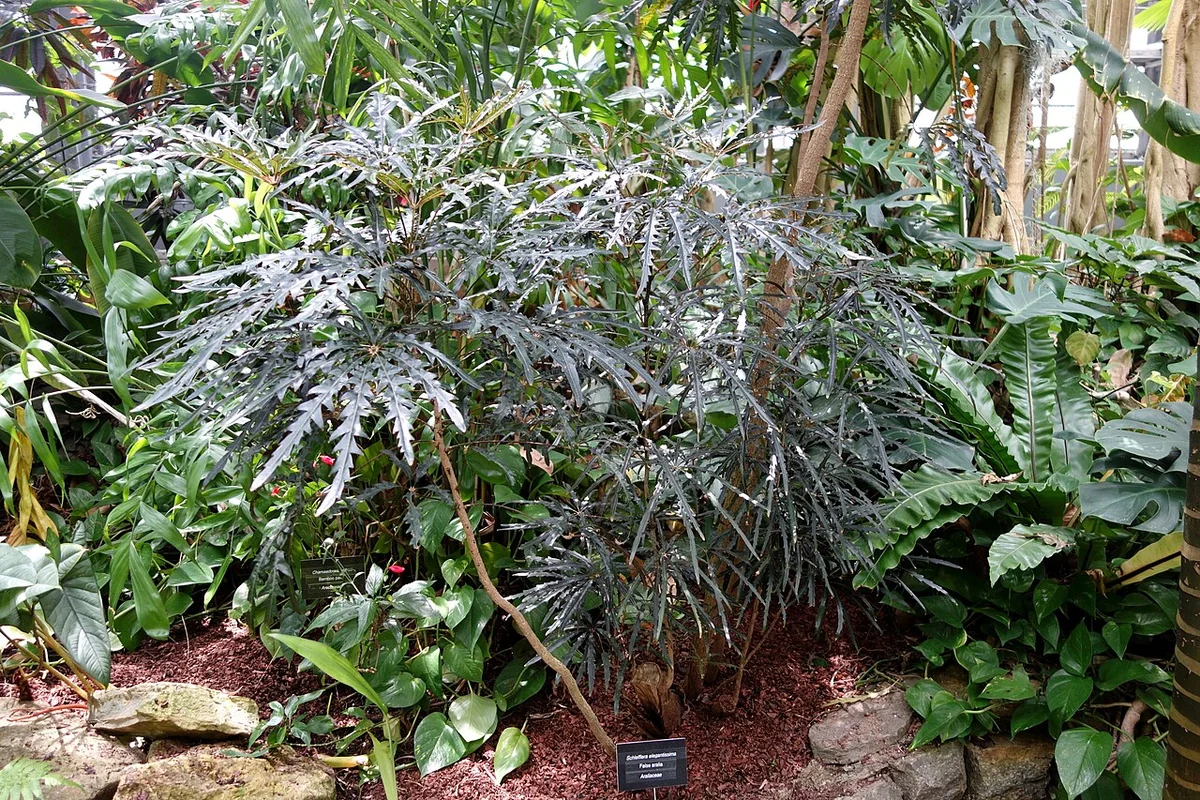
A juvenile foliage form that changes with age
False aralia is prized for a juvenile foliage form that looks almost drawn with a fine pen. Plerandra elegantissima has long narrow serrated leaflets arranged around a central point, often in deep green to bronze tones when young. It is native to New Caledonia and belongs to the aralia family, not to the palms. Older references and nursery labels may use Dizygotheca elegantissima or Schefflera elegantissima. Keeping those names together helps an owner find accurate descriptions. The important surprise is that the leaves change as the plant matures: the narrow juvenile form is a stage of a tree, not necessarily the permanent appearance of every leaf it will ever produce.
Plan for that development rather than choosing the plant solely as a static decorative texture. Mature leaves can become broader and much larger, while the woody framework gains height and width. A small group of seedlings in a nursery pot may create a dense initial display but should still be inspected at each base. Look for firm stems, living tips, and intact young foliage. A tree with a graceful outline is more useful than an exceptionally tall stem already bare below. Give the canopy space away from curtains and traffic, because the fine leaflets can be damaged easily by repeated contact and do not repair a tear afterward.
Light and a workable indoor position
Bright indirect light is the appropriate starting point for most indoor specimens. A location near a substantial window gives the fine canopy a better chance than a dim corner selected because the silhouette looks dramatic against a wall. Introduce any stronger direct sun gradually, especially when the previous nursery exposure is unknown. Observe both new leaf quality and the persistence of older foliage. A tree that loses inner leaves while extending toward one distant bright point may need a different light arrangement. Gentle turning can help distribute available light, but it cannot replace an adequate source or make ordinary ceiling lighting sufficient for a substantial plant.
Water, roots, and a draining container
Keep the root zone evenly supplied with moisture while allowing drainage and some surface drying. Feel below the uppermost layer before watering, then irrigate the complete ball rather than adding little amounts only beside the stem. Empty the outer cover after surplus water has left the pot. The delicate foliage can suffer when a small ball is left dry for too long, yet continuous saturation creates a separate root problem. The interval changes with light, temperature, canopy size, and whether the plant has recently been pruned. A fixed routine copied from a tougher neighbouring houseplant may not suit this more sensitive specimen.
Warmth and ambient humidity deserve attention. Protect the tree from cold doors, a chilly night against glass, and dry air directed from a heater or cooling vent. In a persistently dry interior, a correctly maintained humidifier can be more useful than brief repeated sprays over the leaves. The foliage should not remain wet in stagnant cool air. A stable growing area is especially valuable after purchase, when the tree is adjusting to several changes at once. If leaves drop during that period, inspect moisture and temperature before moving it again. Constant relocation can prolong uncertainty and make the actual cause of decline harder to identify.
Training and ongoing maintenance
Repot only when the roots and moisture pattern justify more space, using an airy mix intended for indoor containers. A modest increase in volume is easier to control than a large tub surrounding a small root system. Retain the established stem depth and avoid unnecessarily stripping the fine roots. In a grouped nursery planting, separation should have a clear purpose and a realistic plan for recovery, not simply a desire to make the base look tidier. A decorative cover must allow the functional inner pot to be removed or drained. Keep the lower stems visible enough to recognize damage rather than hiding them beneath stones and dense wrapping.
Pruning can contain height or encourage a more useful branch arrangement, but it should be staged while the tree is growing strongly. Cut a selected extension above suitable living tissue and leave enough foliage for the remaining framework. A hard reduction of a weak shaded plant is not a dependable route to an instantly full crown. Preserve the character of the leaf clusters rather than repeatedly flattening every tip into the same outline. Appropriate stem material can be propagated under controlled conditions, whereas an isolated leaflet is not equivalent to a complete cutting. Keep the source identity with new plants, particularly where older botanical names are also used.
The many leaflet joints provide places where pests can remain unnoticed. Examine the undersides and protected stems for mites, mealybugs, aphids, thrips, or scale, rather than waiting until a large section of the canopy thins. A gentle rinse can clean a manageable plant if drainage is maintained and the foliage is not left cold and wet. Feed moderately during active extension with a suitable labelled indoor dose. Pale or falling leaves should first be interpreted alongside roots and environment. Increasing fertilizer cannot repair a chilled stem, a dry root ball, or a lack of light, and several simultaneous interventions can make recovery more difficult to evaluate.
Meaning without unsupported promises
The elegant juvenile outline can support a personal gift meaning of refinement, careful detail, or a project developing through different stages. That interpretation should not be confused with a documented universal tradition for the species. Its New Caledonian origin and the change from narrow juvenile foliage to larger mature leaves provide a genuine botanical story. A recipient interested in design or plant development may appreciate that transformation. Avoid assigning the religious or good fortune associations of an unrelated aralia merely because the names overlap. The plant can be meaningful through an accurately described identity and a message specific to the recipient, without promises about luck or health.
A gift matched to the recipient
False aralia is best suited to an owner who enjoys regular observation and has warm bright space with reasonably humid air. It can mark a requested collection addition, a creative milestone, or the establishment of a well lit study. It is a less suitable surprise for a cold office, a dry heater corner, or someone who wants a plant that can be ignored during long travel. Treat foliage as ornamental and consider access by children or pets that chew plants. Choose a manageable healthy specimen and provide all relevant names. The thoughtfulness of the gift lies in matching its delicate character to a realistic home, not merely admiring its appearance in the shop.