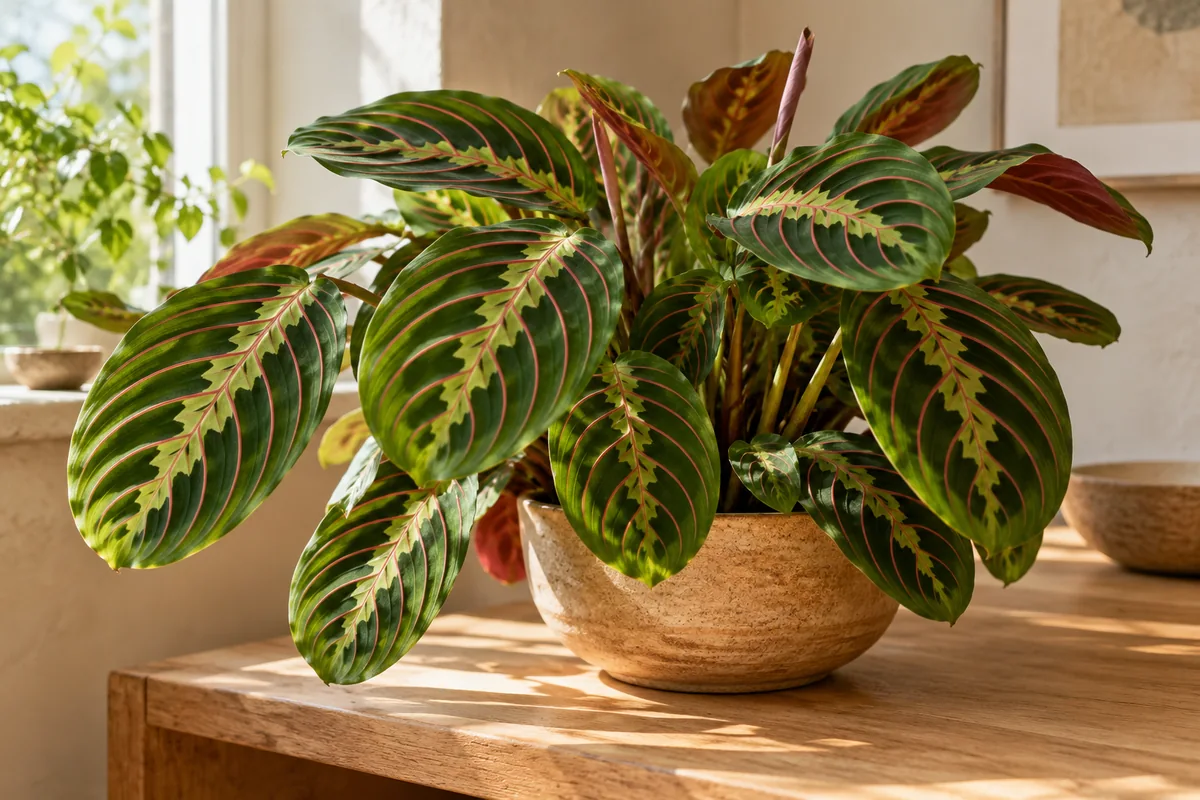
A prayer plant changes its outline between morning and evening without moving its pot. Leaves held outward during the day rise as the light fades, showing more of their colored undersides. That daily movement is part of the plant's normal behavior, so an evening change in posture does not automatically mean it needs water. Maranta leuconeura becomes easier to understand when you look at it at a similar time each day. Compare the condition of the leaves, the feel of the mix, and the room's light together. A stable growing arrangement lets the patterned foliage remain the focus instead of turning every folded leaf into an urgent puzzle.
Provide bright indirect daylight and protection from intense sun. A light curtain or a sheltered position near an east window can work, depending on the room and outdoor shade. Strong afternoon exposure may fade the pattern or leave dry patches. A very dim position can slow growth and make the root ball remain damp for longer than expected. Keep the pot away from cold drafts and heated airflow. The foliage spreads outward rather than forming a rigid upright column, so allow room at the sides. Leaves pressed against walls or curtains are harder to inspect and can remain damp after accidental splashes.
Aim for a gently moist root zone with air spaces, letting the surface begin to dry before watering again. Do not allow the entire root ball to become hard and shrunken. Check beneath the surface with a finger or wooden probe, then water evenly and let excess drain. Empty the saucer afterward. A heavy wet pot does not need another drink simply because a few leaves have curled. Examine the setting and roots first. During a dim cooler period, growth and water use may slow, so the interval between thorough waterings can change substantially without requiring the mix to become completely dry.
Water quality can affect leaf edges. Where the usual supply leaves heavy mineral deposits, water with lower mineral content may be useful. Letting water stand overnight does not reliably remove dissolved minerals or every treatment used in a municipal supply. Use information about the actual water rather than assuming that standing makes it suitable. Brown tips can also reflect uneven moisture, dry air, or excess fertilizer, so review those factors together. Existing dry tissue stays dry. The appearance of fresh leaves over the following weeks offers a clearer measure of whether the change is helping than repeated trimming of old edges.
An open moisture retaining mix supports the fine roots better than dense garden soil. Choose a draining container only modestly larger than the root system. Repot during active growth when roots have filled the space or the old mix has lost its structure. Keep the plant at its previous depth and avoid covering stem bases with a thick new layer. Maranta can spread along the surface, making a broad modestly deep pot useful when its roots justify the space. A tiny division in a very large container remains difficult to water evenly. Match the pot to the roots rather than to the size of the hoped for display.
Indoor humidity matters to the thin patterned foliage. A properly maintained humidifier can provide a more sustained change than occasional misting, particularly in a room made dry by heating. A bright bathroom may offer a useful setting, provided it also has enough daylight and remains warm. Do not place the plant in a dark room solely because the air feels damp. Allow gentle circulation around the leaves. Crowding the pot tightly among wet surfaces can create a different problem without improving growth. Support soft stems when cleaning and use a gentle damp wipe rather than scrubbing the colored leaf surfaces.
Feed lightly while new leaves and stems are developing, following the product directions and considering nutrients already present in fresh mix. Strong or frequent feeding can contribute to salt buildup around sensitive roots. If a crust appears on the mix or container, review the routine and flush a freely draining pot when appropriate. Prune a stretched stem just above a suitable node during active growth if the plant needs a fuller outline. Rooted divisions should retain several leaves and established roots. Avoid making a major division while the plant is already adjusting to a recent move, a damaged root ball, or a prolonged dry period.
Watch new leaves as they emerge rolled and gradually open. Allow them to unfold without pulling at the edges, which can leave lasting creases. A useful routine combines a brief moisture check with an inspection at roughly the same time of day, making normal movement easier to recognize. If several leaves curl persistently through daylight hours, look at the root zone, dry airflow, and sun exposure together. Make one practical adjustment and allow time for fresh growth to respond. Soft filtered light, steady root moisture, and room for the stems to spread let a prayer plant show its daily movement without constant intervention.