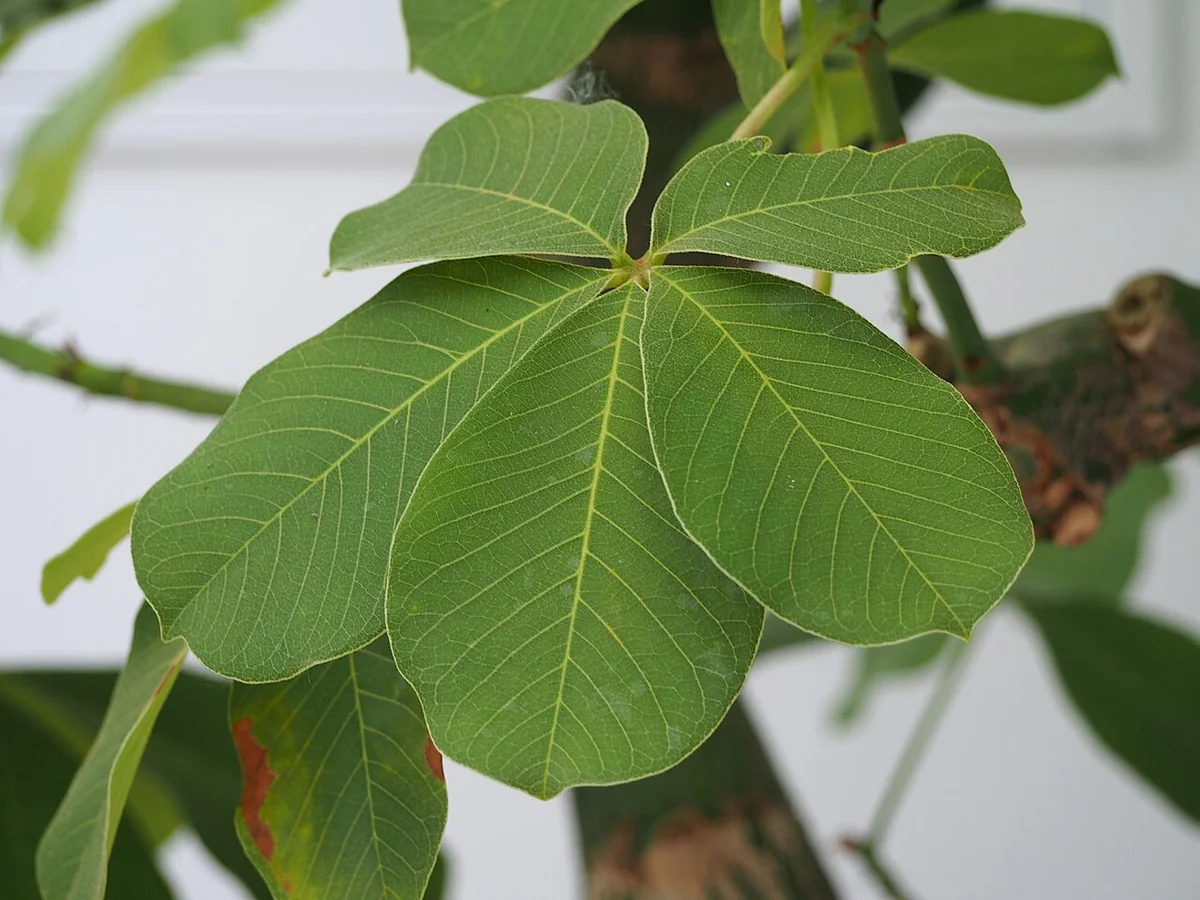
A sculptural trunk with a seasonal canopy
The shaving brush tree asks its owner to appreciate a trunk as much as a leafy crown. Pseudobombax ellipticum can develop a swollen base and patterned greenish bark that make a young container specimen visually unusual. Its natural range includes Mexico and parts of Central America, where it can become a substantial tree. A pot limits the root space and offers a way to cultivate it under protection, but it does not convert the species into an ordinary evergreen office plant. Bright growing conditions, seasonal observation and room for its eventual structure are central to keeping it successfully.
The common name refers to the large flowers with masses of projecting stamens, often pink or white depending on the plant. Those blooms are an impressive feature of mature specimens, yet a small indoor tree should not be sold as a dependable annual flower display. The compound leaves themselves are distinctive, with several leaflets arranged around a shared point. New foliage may carry reddish tones before turning green. Keep the botanical name with the specimen because the word bombax is used loosely for several related trees. Identification matters when comparing mature size, leaf behaviour and the care appropriate to the dormant season.
Light must reach the growing crown
Give an actively growing shaving brush tree a bright position, with substantial sun after it has been acclimated. A sunny conservatory usually offers a more credible setting than a room whose only daylight comes through a distant door. Strong illumination helps support the trunk and canopy development for which the plant was chosen. Glass can create intense heat as well as transmit light, so combine the position with suitable ventilation. Observe the upper branches as the tree gains height. A trunk placed attractively beside a window does not guarantee that leaves higher than the window will receive enough useful light.
A protected summer outside can improve its growing conditions when local temperatures are suitable. Introduce exposure gradually rather than assuming the dry habitat association means that leaves raised indoors can immediately withstand full outdoor sun. Secure a tall pot against wind and avoid a location where a swollen base could be struck by tools or furniture. This is not a frost hardy tree. Arrange warm enough shelter before cold weather threatens and avoid leaving the root ball on a freezing surface. Moving a large container should be planned in advance, since its interesting trunk is also the part that can be damaged during awkward handling.
Read seasonal leaf loss before adding water
Pseudobombax ellipticum can lose its leaves seasonally. A bare tree is therefore not automatically a dead tree or one that should receive more water until it produces leaves. Compare the season, temperature, firmness of the trunk and condition of the roots. During a genuine resting period, water use falls substantially because the leafy canopy is absent. Continued heavy watering can leave roots wet for much longer than expected. This is one reason a shared office watering rota can be unsuitable: someone seeing an empty crown may try to rescue the plant with the very treatment it currently needs less of.
During active leafy growth, supply water according to the occupied root ball and allow it to drain completely. Do not apply an extreme dry cactus routine simply because the trunk stores reserves. Use a porous container medium and a pot with open drainage holes, and let the root system rather than the desired visual scale determine the next pot size. A huge reservoir of unused wet mix is difficult to manage around a resting tree. Keep the root collar at an appropriate level. Burying an attractive swollen base to stabilise the plant sacrifices the very feature being grown and can create an unnecessarily damp contact zone.
Build the framework while the tree is small
A container shaving brush tree may be shaped to encourage lower branching and a balanced compact silhouette. Make those decisions while the branches are manageable rather than allowing a long unsupported stem and then removing its entire crown in desperation. Its natural tree size remains relevant even in a small collection. Decide whether the aim is a sculptural young specimen, a carefully trained display or an eventual large conservatory tree. Each aim calls for a different amount of room. Retaining enough leaves to support recovery after pruning is more useful than demanding immediate miniature proportions from every new shoot.
Feed measured amounts during the period of active growth, following the product instructions and the condition of the medium. A leafless resting plant does not require fertilizer simply because feeding day has arrived for the other conservatory plants. Record when foliage is shed and when the next flush begins so the seasonal cycle becomes familiar. Repot when root condition justifies it and the tree can recover in suitable warmth and light. Avoid unnecessary disturbance of a sound established base. The plant's unusual appearance is not evidence that repeated root exposure or decorative rearrangement will improve its development.
Flowers are a possibility rather than a contract
Flowering depends on maturity and appropriate growing circumstances, and a restrained container specimen may remain principally a foliage and trunk plant. Do not interpret every year without flowers as a nutritional failure. Inspect the leaves for mites or other pests while they are present, especially after an outdoor season. Check bare branches and the lower trunk as well, since a seasonal rest should not conceal physical damage or an infestation. A soft or discoloured base warrants a careful assessment of moisture and roots. Spraying an unrelated leaf product cannot correct decay at a constantly wet root collar.
As a gift, this tree suits a collector who enjoys caudex plants, unusual bark or seasonal changes in a living sculpture. A personal message about patience can fit the experience of waiting for a new canopy, but it should not be represented as established folklore associated with the species. Explain the possibility of a bare season before choosing it for someone who expects permanent greenery. A recipient who regularly discards dormant plants or waters every pot identically may find it frustrating. The gift works best when the sculptural trunk itself is valued and the owner has a suitable bright frost free place to learn its rhythm.
Pass on the seasonal history with the specimen
Include the exact botanical identity, the last period of leaf loss and the recent watering pattern when moving the tree to another home. Supply its nursery origin and flower colour only when these are actually known. Keep the pot stable and the swollen trunk protected during transport, using support that does not rub through the bark. Give the new owner time to establish a routine before asking the plant for flowers or dramatic trunk enlargement. A shaving brush tree rewards observation of structure and season. Its value as an indoor collection specimen comes from those real features rather than a promise of effortless tropical blooms.