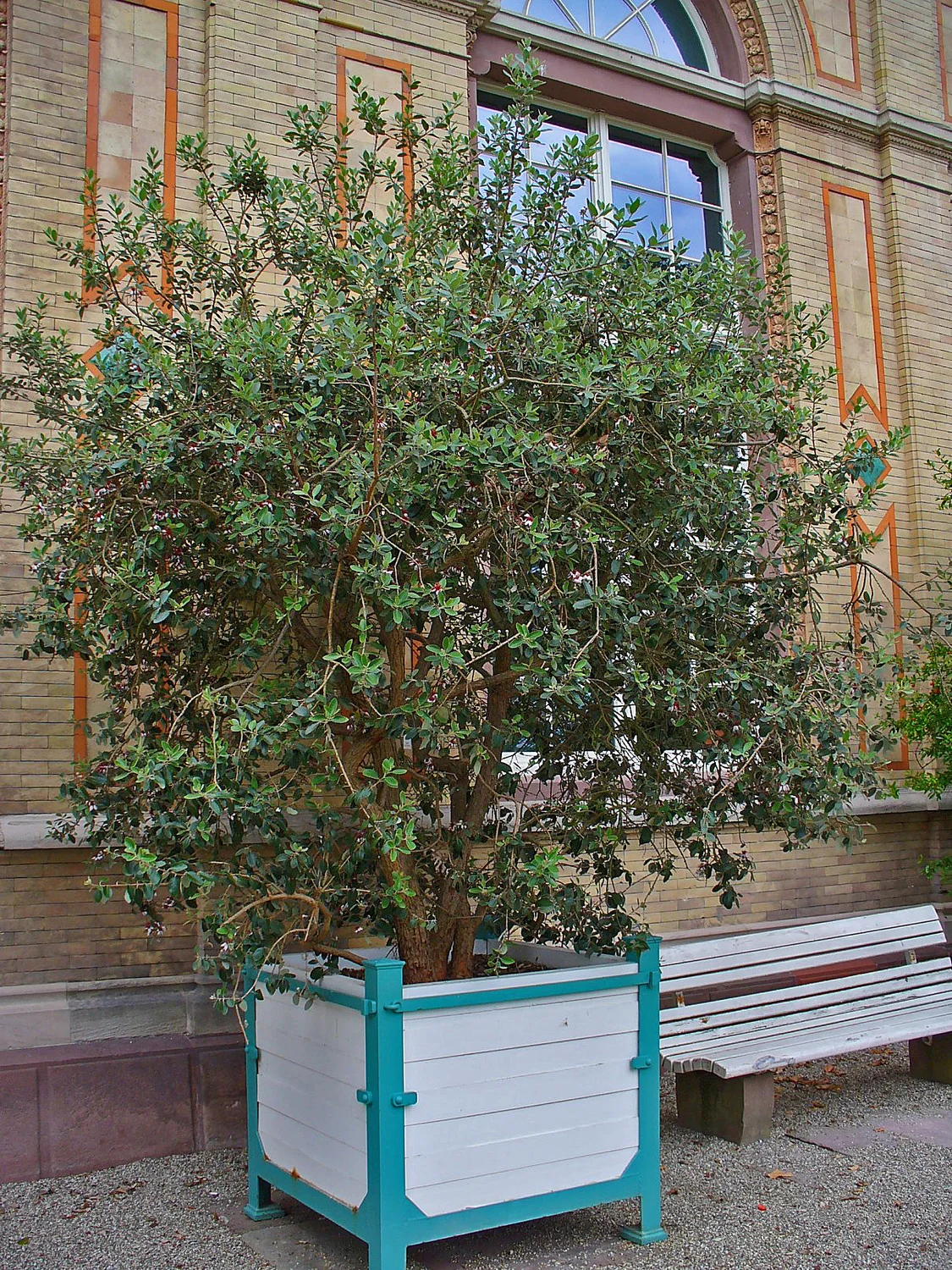
A silvery fruit tree for a sunny conservatory
Pineapple guava makes its strongest visual impression when a breeze or a small change of viewing angle reveals the silvery backs of its leaves. Acca sellowiana is an evergreen South American shrub or small tree, also familiar under its older botanical name Feijoa sellowiana. It is a relative of guavas in the myrtle family rather than a pineapple or a citrus. In a container it can develop a handsome woody framework, but that does not make it a conventional low light houseplant. Think of a sunny conservatory specimen or a patio tree with suitable winter arrangements before considering an ordinary office position.
Its thick opposite leaves, pale undersides and distinctive flowers provide interest even without a fruit crop. The flowers combine fleshy pale petals with conspicuous red stamens and can be particularly striking against the grey green canopy. Named selections have been developed for fruit quality and other features, and their pollination requirements are not all alike. A seedling sold simply as feijoa should not be assumed to have the performance of a named fruit cultivar. Preserve the nursery label and ask about its parentage or propagation. Those details determine whether fruit ambitions are realistic and whether another compatible selection might be useful.
Match the light to flowering ambitions
Give pineapple guava strong light, with direct sun where the growing space can provide it safely. North Carolina Extension identifies full sun as the best exposure for flowering and fruiting, although the plant tolerates some shade. Indoors, tolerance should not become an excuse to place it far from a window. Glass, curtains and neighbouring structures can substantially reduce what reaches the crown. Observe the actual sun moving across the space. A room that feels bright to a person may still offer a tree very little energy, especially during a winter of short days and low sun angles.
This is also a tree for which a summer outdoors can be useful. Introduce a protected specimen gradually to greater sunlight and wind rather than moving it directly onto exposed paving. Unlike cacao, pineapple guava is associated with a cooler growing pattern and can tolerate conditions that would harm many tropical foliage trees. Nevertheless, a container root ball is more exposed than roots in the ground, and a local hardiness rating is not a complete overwintering plan. In cold regions use a bright protected space and avoid abrupt freezing at the pot. Warm dim winter accommodation is an awkward substitute for light and appropriate seasonal conditions.
Moisture supports a crop without flooding roots
Use a draining container medium that retains useful moisture, particularly when a leafy tree is making growth or carrying fruit. The species tolerates a range of landscape soils, but that adaptability does not mean dense garden soil will perform well in a pot. The shallow root system needs an even supply of water and careful handling. Inspect the occupied root ball rather than applying a fixed quantity to a large outer container. Water thoroughly when the condition calls for it and allow drainage. A tree outdoors in wind may use water much faster than the same specimen in a cool protected room.
Do not make drought tolerance a fruit production strategy. Extension guidance specifically connects consistent moisture with good fruit quality. Equally, a constantly flooded pot is not a way to guarantee that consistency. Check deeper material when the surface seems dry, and adjust watering during cooler slower periods. Keep any decorative mulch thin enough that root condition and watering remain observable. If the plant wilts over wet medium, examine drainage and root conditions before adding another dose. Heavy containers deserve a practical inspection method, since a pot that is difficult to move is easily left sitting in unnoticed runoff.
Shape the crown without erasing its character
A pineapple guava can grow as a rounded shrub, a loose small tree or a trained specimen, depending on the starting material and the owner's purpose. Selective pruning helps establish a readable framework and control width. Repeated shearing into a dense ball produces a different result from retaining the slightly open branching that makes the silvery leaves visible. Remove damaged or poorly placed branches thoughtfully and avoid combining every major intervention at once. The tree still needs enough foliage to recover after root work. Before choosing a tall standard, check whether its crown and pot can pass through the doorway used for seasonal moves.
Nutrition should support measured container growth, with the product rate and the existing medium taken into account. A fertilizer cannot compensate for insufficient sunshine or incompatible pollination. If flowers appear without a crop, examine cultivar identity, access for pollination and the general growing conditions before changing feed repeatedly. Some named selections are self fruitful, while others benefit from or require a suitable partner for dependable production. Even a self fruitful tree is not a guarantee of ripe fruit in a short indoor growing season. Retain the leaves and framework as worthwhile features rather than judging every year by a harvest photograph.
Fruit is a separate responsibility
The species has edible flowers and fruit, but a nursery ornamental should not automatically become a food source. Confirm its identity, treatment history and suitability for food use before tasting anything. A cultivar's ripening pattern also deserves specific guidance rather than a general instruction based on a different guava. Handle fruit carefully and remove fallen material before it attracts insects indoors. Examine the leaf undersides and stems for scale or other pests, particularly before returning an outdoor tree to the conservatory. Early observation is more manageable than discovering a concealed infestation after the canopy has been placed among other treasured specimens.
As a gift, pineapple guava suits someone who enjoys Mediterranean style planting, edible collections or the contrast between silver foliage and dark wood. Those are design and personal associations, not claims of a traditional universal meaning. A housewarming gift could suggest a long term growing project if the recipient has a sunny protected space and wants one. It becomes burdensome when presented to a person who has only a desk under ceiling lights. Discuss the likely mature container size, seasonal moving and fruit expectations first. A compact specimen with an identified cultivar is usually a more considerate choice than an impressive heavy tree with no practical growing plan.
Keep the feijoa name with the care history
Include both Acca sellowiana and the familiar feijoa name when passing the plant to another grower. Record any cultivar and whether it is grafted, rooted from a cutting or raised from seed. Supply recent repotting and watering information without pretending the same interval will suit every home. Select a stable container that permits complete drainage and inspection. The recipient's first task is to learn the tree's response to the new light and seasonal setting. An established canopy, steady roots and a manageable framework are substantial achievements. Flowers and fruit can enrich that relationship when the environment and cultivar allow them to develop.