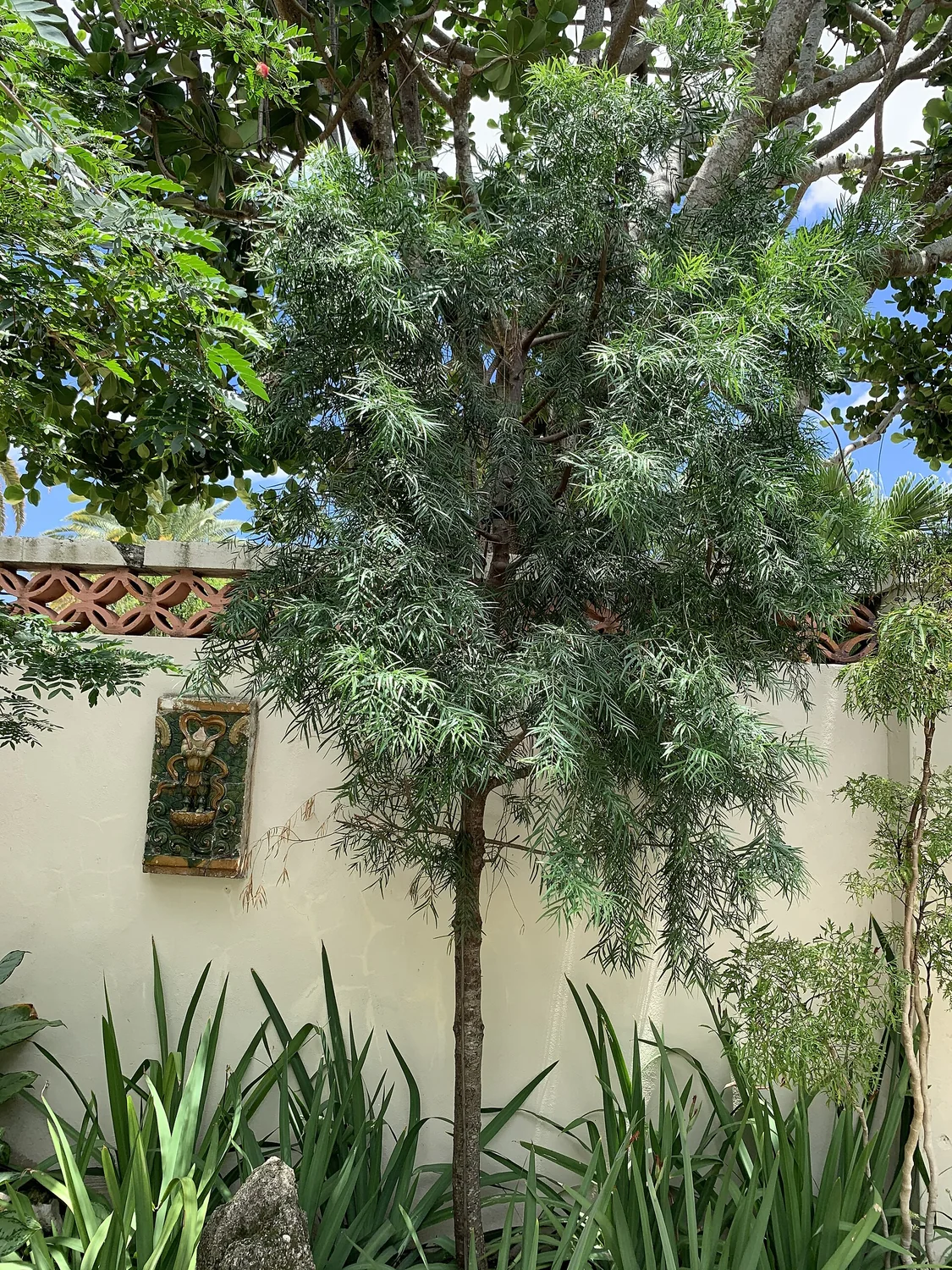
An African conifer behind the fern pine name
African fern pine combines fine evergreen texture with the framework of a real tree. Its narrow leaves can give a young specimen a fernlike softness, but Afrocarpus gracilior is a conifer rather than either a fern or a true pine. It is also encountered under the older name Podocarpus gracilior, and some references discuss it in relation to Afrocarpus falcatus. Kew accepts Afrocarpus gracilior as a species native from Ethiopia into eastern tropical Africa. Retain that naming information when buying or giving a plant, because the common phrase fern pine can otherwise lead to a misleading mixture of unrelated care descriptions.
The natural scale is important to an honest indoor assessment. This is a tree of African forest environments and a landscape tree in suitable warm regions, not a naturally small ornament bred for a dark office. A young container specimen can be maintained in a bright protected growing area, but its eventual need for space and shaping should be acknowledged. A conservatory or substantial glazed interior is a more credible setting than a remote desk. Choose a plant with a balanced crown, firm trunk, and living lower branches. A tall narrow nursery plant may already have a canopy that is much wider than its pot suggests.
Light and a workable indoor position
Provide strong usable daylight across the whole framework. A position near large windows can work if temperatures and water management are also suitable. Introduce direct sun gradually when nursery exposure is unknown, and avoid confining previously shaded foliage against hot glass. Observe the newest shoots and the persistence of leaves on the inner branches. If only the outer tips near a window remain active, the interior position may be too dark. Turning the pot can distribute existing light more evenly but cannot replace a sufficient light supply. A correctly arranged growing light may be necessary where the intended room does not offer enough daylight.
Water, roots, and a draining container
Water thoroughly when checking shows that the root ball has lost enough moisture to need another drink. Let the upper mix dry somewhat while ensuring the deeper roots are neither continually saturated nor repeatedly dried hard. The foliage's fine appearance should not be used as a fixed measure of its water demand. Pot size, root density, ventilation, and seasonal light all affect the interval. Drain freely and remove surplus from any outer vessel. A plant moved into a dimmer cooler space can remain wet much longer, so the previous routine should be adjusted from observation rather than continued until yellowing makes the mismatch obvious.
An open structurally stable container medium makes that balance easier to achieve. Increase pot size when roots occupy the old space and the watering pattern becomes difficult, but keep the change proportionate. A large tub of dense mix around a small root system can stay wet in areas the tree is not using. Preserve the established stem depth and inspect the visible base without burying it beneath decorative compost or stones. A heavy outer pot can improve stability while the inner container remains correctly sized. Make sure the drainage route can still be reached when the canopy has grown and moving the tree has become less convenient.
Training and ongoing maintenance
Training should preserve the light texture of the plant. Shorten selected overlong shoots above useful living growth rather than repeatedly cutting every outer tip into a dense surface. A young flexible stem can be supported loosely while it strengthens, and ties should be inspected before they press into the bark. Do not assume that a bare old branch under poor light will immediately rebuild after a severe cut. If the tree is outgrowing its interior position, consider whether a better growing area is available. A potentially large conifer should not be sold as a permanent tiny display maintained through repeated emergency reductions.
Maintenance is an opportunity to check the fine leaves and protected branch junctions. Scale, mealybugs, and mites can be easier to detect before the crown becomes visibly sparse. Clean dust gently without bending twigs or stripping leaves from their bases. A single browned branch following a dry episode has a different context from general yellowing above wet mix. Feed conservatively when the tree is extending under adequate light, following an indoor rate and accounting for fertilizer already included in new compost. Nutrients cannot replace illumination or restore roots that remain deprived of air. Keep the pace of care tied to actual growth rather than the outdoor potential of the species.
Its forest origin should not be reduced to a single household humidity rule. A humidifier may help a very dry interior, yet roots, light, and temperature still need to be appropriate. Keep the tree away from concentrated heater air and abrupt cold drafts. If summer outdoor culture is part of the plan, acclimate the plant and identify a safe return route before its canopy expands. Do not casually plant an unwanted specimen outside where future size or local ecological considerations have not been assessed. Reproductive structures, if ever present, are not an invitation to taste an ornamental plant. Keep fallen material away from children and animals that investigate the pot.
Meaning without unsupported promises
The phrase fern pine can inspire a personal gift message about combining softness with strength, but that is a visual interpretation rather than an established universal tradition. The species' genuine story is the history of African conifers and the changes in botanical classification that distinguish Afrocarpus from Podocarpus. Do not transfer the national or sacred symbolism of a different yellowwood simply because both belong to the same family. A recipient interested in forests or plant evolution may appreciate an accurate account of that relationship. No promise about fortune, healing, or air purification is needed to make an unusual living conifer interesting.
A gift matched to the recipient
African fern pine is best offered as a requested plant for an experienced owner with bright protected space. A conservatory opening, a collection milestone, or a gift linked to an interest in African forests can be appropriate. It is a poor surprise for someone seeking an easy tree for a dim office corner. Agree on the starting size, eventual canopy, and access needed for watering and repotting. Include both the current and older botanical names so the owner can reconcile references. A manageable juvenile with a sound root arrangement respects the recipient's circumstances more than a large impressive tree whose continuing care has not been considered.