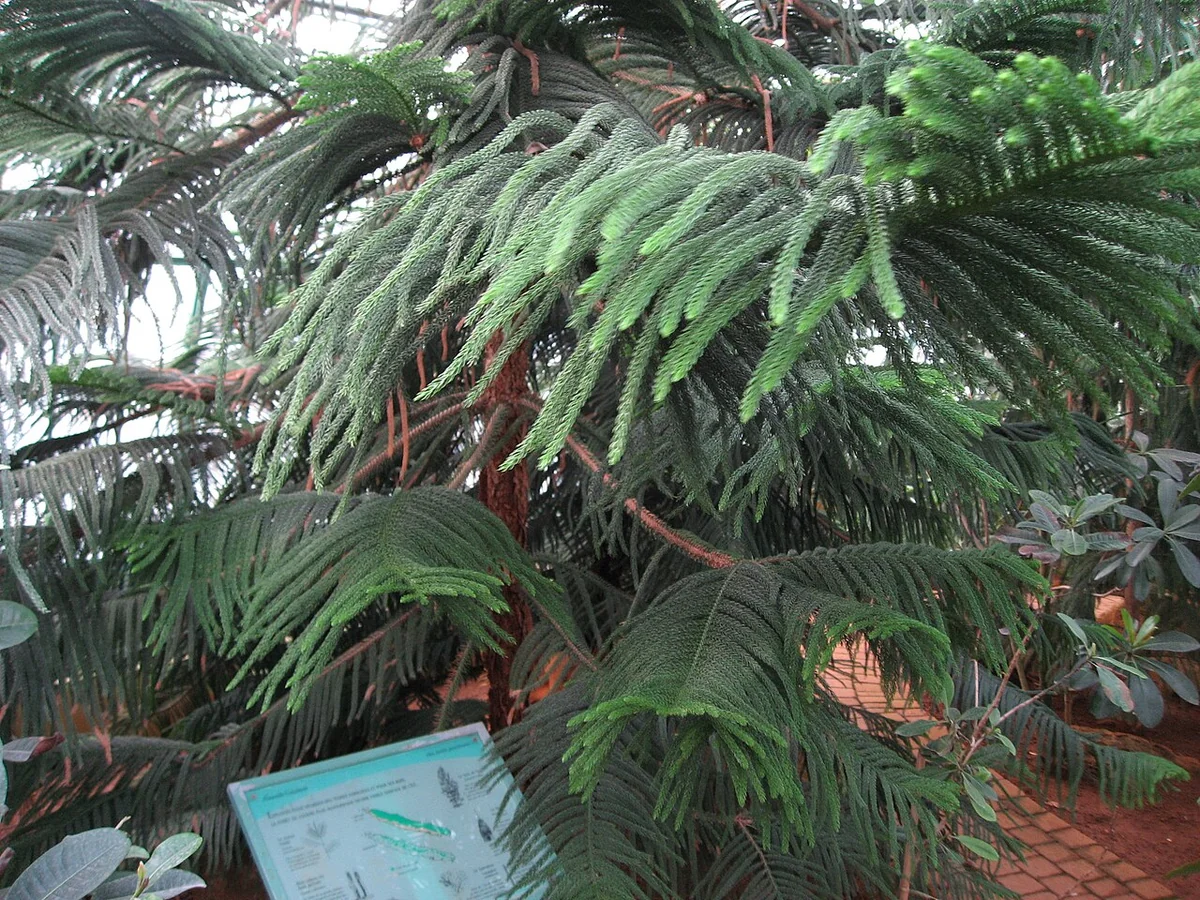
Cook pine and its New Caledonian origins
Cook pine is a distinctive conifer from New Caledonia whose narrow mature silhouette has made it a landmark tree in many warm gardens. Araucaria columnaris is closely similar to Norfolk Island pine when young, and the two may be confused in seasonal retail stock. Its native coastal background does not make it a cold tolerant northern pine. A juvenile in a container can be an attractive protected foliage tree, but its long term scale should be stated honestly. The tall columns seen in botanic gardens are mature expressions of the same species, not an unrelated landscape form with no bearing on the small plant's future.
Keep identification with the tree whenever possible. A reliable nursery record or collection label is more useful than assuming that every plant sold as a living Christmas tree is Araucaria heterophylla. Young branch and leaf features can overlap in general appearance, making casual photographs insufficient for a confident distinction. Several seedlings may be grouped to create fullness, and each should have a healthy leader and firm lower stem. Check the overall balance rather than buying a tree solely because it is tall. A specimen already bare on its shaded side may need an improved light arrangement before it can become a lasting interior plant.
Light and a workable indoor position
Use the brightest suitable indoor position available, with gradual adjustment to stronger direct exposure. A warm conservatory or a room with large windows offers a more credible growing environment than the centre of a dim office. New growth should remain reasonably balanced around the trunk instead of concentrating toward one window. Rotate the container a little at a time if necessary. The tropical coastal origin also makes repeated cold drafts undesirable. A glazed room that is comfortable during a sunny afternoon may become much colder overnight, so assess its minimum conditions rather than selecting it from daytime appearance alone.
Water, roots, and a draining container
Water in response to the pot's drying pattern. The fine branchlets should not be subjected to repeated complete root drying, but a permanently saturated cover pot is equally inappropriate. Check the upper layer and deeper moisture, then wet the full ball when needed and let the excess drain. A small seedling group can have a tightly filled nursery container that dries faster than the decorative outer pot suggests. After repotting, surrounding fresh mix may stay wetter than the original central ball. Those differences deserve inspection instead of a single automatic weekly dose. Remove wrapping that prevents the base and drainage water from being seen.
Choose a structurally open medium and a stable pot proportionate to the current roots. When repotting is justified, increase size moderately and retain the existing depth of the stems. Avoid using a huge volume of dense compost to anchor a top heavy tree. A heavier outer vessel can provide stability while the functional inner container remains appropriately sized and drainable. Carry the plant by supporting the pot, never by grasping the delicate tiers of branches. In a grouped planting, consider whether the root system is sound before attempting separation. A nursery arrangement need not be dismantled simply because several trunks are present.
Keeping the leader and branch tiers
Respect the main leader and the naturally tiered framework. Cutting the top off to fit a ceiling can permanently alter the tree's appearance, and lost lower branches do not quickly return as a complete new skirt. Select a specimen that has room to grow rather than planning on frequent topping. Remove dead material carefully where necessary, while distinguishing irreversible browning from normal differences in the colour of young foliage. If the plant's scale is becoming unsuitable, seek a credible alternative location instead of repeatedly forcing the structure into a smaller outline. Its architectural character depends on allowing branches and leader to remain coherent.
Brown tips or branches need a history of the growing conditions. Investigate missed watering, prolonged saturation, dry heater air, cold exposure, and the degree of light before assuming a nutrient shortage. Gentle cleaning and inspection can reveal scale or mites without subjecting branchlets to rough handling. Feed conservatively during active growth, following an indoor container rate rather than the requirements of an outdoor tree in tropical sunshine. A quiet period under reduced daylight calls for restraint. Taking notes after a move or a change in heating can help connect a later symptom to a real event instead of prompting a sequence of guesses.
Cook pine has a documented role as a living Christmas tree substitute in tropical regions. If used that way indoors, decorations should be lightweight and temporary. Avoid artificial snow coatings, hot lights, or heavy objects that bend the branch tiers. Keep cords and ornaments away from children and pets, and do not allow foliage to become a chewing toy. The seasonal display location should still provide adequate light and access to watering. A tree left far from a window for weeks may emerge from the celebration with damage that is difficult to reverse, even if the surrounding decorations looked attractive throughout the event.
Meaning without unsupported promises
Its real historical context includes its movement into botanic gardens and warm ornamental landscapes beyond New Caledonia. That can support a message about travel, botanical curiosity, or the distinctive outline of an island tree. A personal interpretation of upright growth or continuity is reasonable when identified as such. It should not become a promise of good fortune or a claim that every culture assigns the species the same meaning. The common name Cook pine also should not be used to romanticize a complicated history without evidence. For a household gift, the tree's native geography and its living architecture provide enough truthful interest.
A gift matched to the recipient
Offer Cook pine to someone who has requested a conifer for a bright protected space, or who can maintain a seasonal tree after the holiday ends. A conservatory addition, a botanical collection milestone, or a warm climate winter celebration may suit it. It is a less appropriate surprise for a dark desk or a room where the leader will immediately meet the ceiling. Confirm the plant's identity as far as the source permits and pass that information to the recipient. A stable pot, manageable starting size, and an honest discussion of future growth are more generous than presenting a large tree whose only available position is unsuitable.