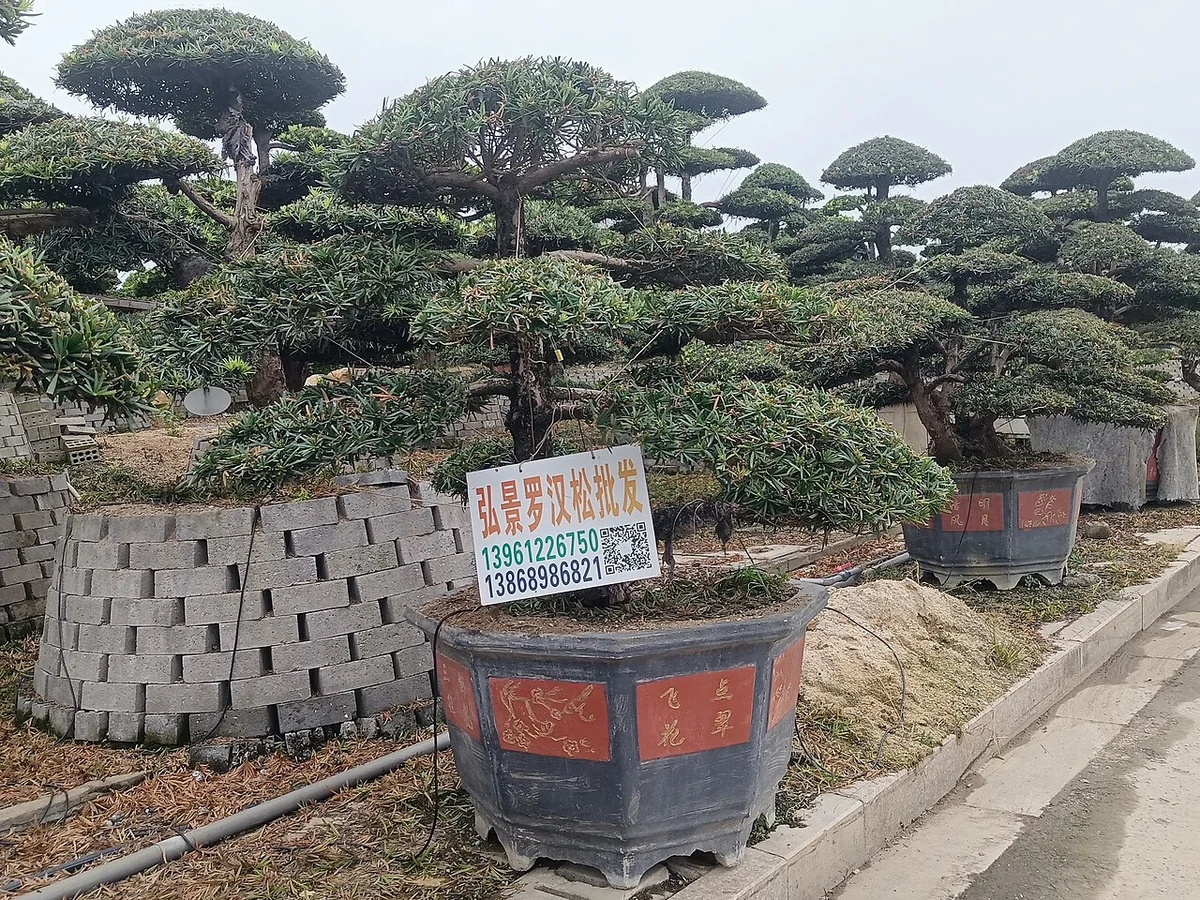
A conifer with flat leathery leaves
Buddhist pine is a conifer whose long flat leaves can surprise someone expecting the needles of a familiar pine. Podocarpus macrophyllus belongs to the yellowwood family, Podocarpaceae, and is native to parts of East Asia, including China and Japan. It can become a substantial evergreen tree or shrub outdoors, while compact selections and young container plants provide a smaller cultivated form. The common name does not place it in the true pine genus. Its attraction indoors is the arrangement of narrow leathery leaves around a woody framework, especially when that framework receives enough light to remain furnished rather than becoming a bare trunk topped with greenery.
Choose the selection and starting size deliberately. A compact named form can be much easier to accommodate than a vigorous landscape seedling sold at the same small nursery height. Several stems may create a dense shrub, whereas a trained standard presents a more tree like outline. Examine the leader, lower branches, and root base before buying. A young conifer's existing structure matters because missing lower growth may not be restored quickly under indoor conditions. If the intended location is a bright conservatory rather than an ordinary living room, say so clearly in the care plan. This distinction is more useful than calling every container plant an easy houseplant.
Light and a workable indoor position
Give it strong light near a substantial window, with gradual acclimation to direct sun where appropriate. Deep shade inside a building is not equivalent to the partial shade a landscape tree can tolerate outdoors. Watch whether new shoots are compact and whether lower branches retain leaves. If the whole framework leans toward one exposure, repositioning or a suitable growing light may be needed. A cooler bright protected room can be more credible than a hot dim office. Avoid pressing foliage against cold winter glass, and assess the lowest night conditions before deciding that a conservatory offers adequate protection throughout the year.
Water, roots, and a draining container
Check root moisture before watering and allow some drying at the surface without repeatedly desiccating the entire ball. Apply water over the full root area, let surplus drain, and remove it from the cover or tray. A conifer's evergreen foliage can remain apparently firm for a time after the roots have become too dry, so waiting for a dramatic wilt is a poor routine. Conversely, persistent saturation can cause root decline even when the leaves still look green. Compare pot weight and deeper moisture, especially after a move into lower light or after pruning has reduced the amount of foliage using water.
Use a draining container mix and a pot matched to the present roots. When the root system occupies its space and watering becomes difficult, make a modest increase in volume rather than surrounding it with a large mass of wet unused compost. Keep the trunk at its original level. A large decorative planter can hold a functional inner pot on a stable support, but its base must remain accessible so it does not become a hidden reservoir. Specialist miniature tree training uses a different root management discipline from ordinary indoor cultivation. Do not assume that a shallow sculptural pot is automatically appropriate because the species is sometimes trained that way.
Training and ongoing maintenance
Prune with the living branch pattern in mind. Selected shoots can be shortened while useful foliage and viable growing points remain, and compact forms may need only modest shaping. Avoid treating an old bare interior as if it will necessarily regenerate immediately after a severe cut. A healthy young plant in suitable light has more capacity to respond than a weakened tree in shade. Keep tools clean and remove clipped material from the pot. If a formal shape is wanted, preserve enough openness for light to reach inside rather than allowing a dense green outer shell to conceal declining branches.
Dust can be removed carefully along the flat leaves, supporting the twig rather than pulling against the branch. Inspect their undersides and the stem junctions for scale or mealybugs, and watch for mite damage in dry interiors. New pale growth may be normal, while persistent yellowing or damaged tips require a review of moisture, roots, and exposure. Feed lightly during active growth, following an indoor container product's instructions. The demand of a tree in open garden soil is not a useful dose guide for a restrained pot indoors. If growth is quiet during winter, avoid using fertilizer to compensate for a reduced supply of daylight.
The fleshy seed structures sometimes seen on mature outdoor plants should not be presented as an expected indoor harvest. This is an ornamental conifer, and the different parts of a podocarp's reproductive structure are not interchangeable food items. Prevent casual eating of foliage, seeds, or fallen material by people or animals. A lack of cones or seed does not indicate poor household care. If decline appears, begin with the growing conditions and root state rather than trying to stimulate reproduction. Its value as an indoor tree rests on sound foliage and structure, not on obtaining every feature visible on a mature specimen in a botanical garden.
Meaning without unsupported promises
The common name Buddhist pine points toward a horticultural association, but it should not be used as a licence to invent a single religious meaning for every plant. Podocarps have a long place in East Asian ornamental gardening, and a carefully shaped specimen can be appreciated in that context. A giver may personally connect its evergreen form with patience or continuity while explaining that this is a chosen message. It is not a guarantee of longevity, protection, or fortune for the owner. Respectful naming and accurate plant information offer a more meaningful introduction than a decorative legend presented without a source or cultural setting.
A gift matched to the recipient
This tree can suit an experienced grower marking a conservatory addition, a new bright study, or a requested botanical milestone. Confirm whether the recipient wants a normal container tree or the more specialized commitments of miniature training. A compact healthy selection is often a better gift than an already large landscape plant. Consider the actual window, winter temperature, access for watering, and pets that chew leaves. Keep the scientific name and selection label with the plant so future size can be assessed realistically. A suitable home and manageable root arrangement give the symbolism a practical foundation rather than leaving the recipient with an unwanted maintenance problem.