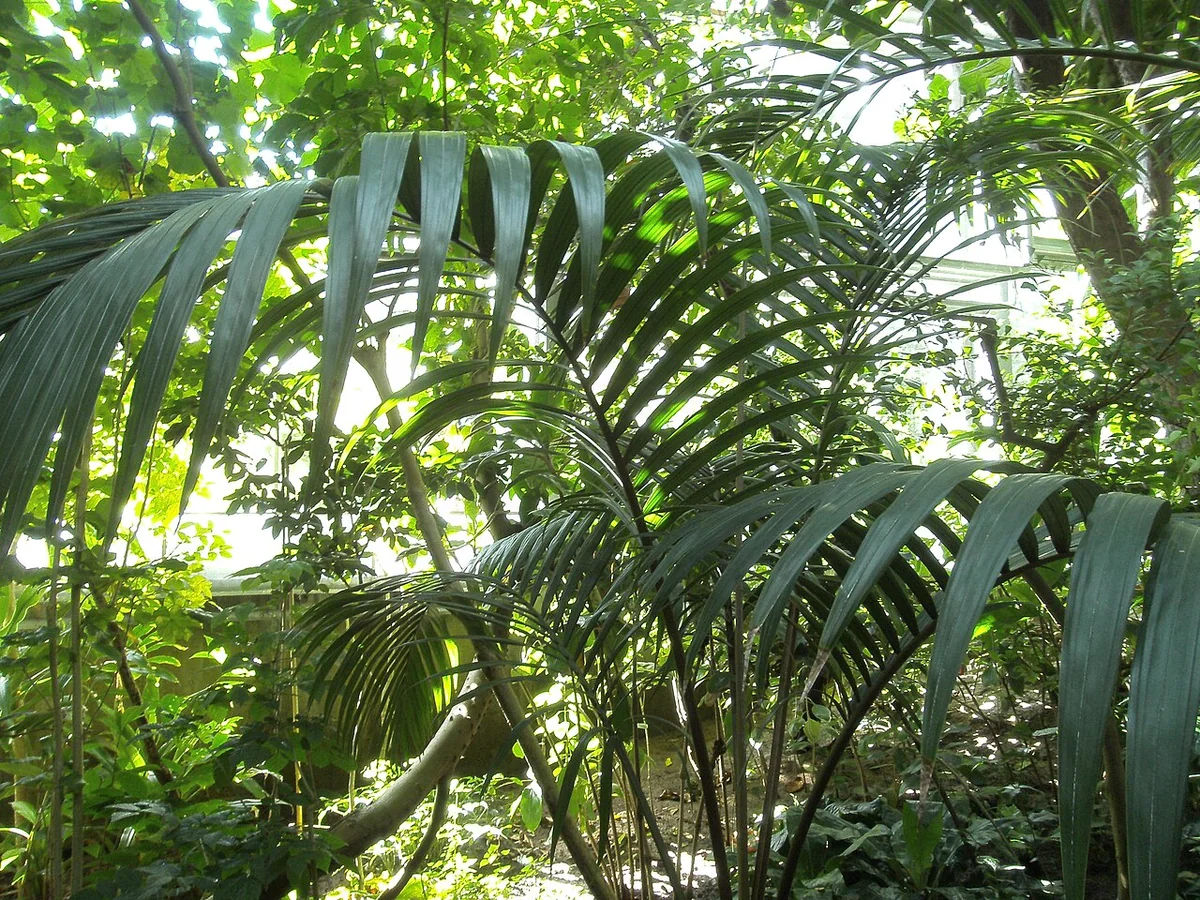
A Taiwan Forest Palm beyond Its Dwarf Name
Arenga engleri is a palm with a substantial presence, despite the word dwarf in its common name. Its clumping stems carry long feathered leaves whose leaflets have a distinctive, somewhat irregular outline. An established group can spread broadly, so a small nursery pot is only an early stage of the plant's architecture. The Taiwan sugar palm is most convincing in a spacious, bright collection area or conservatory where its structure can develop. It should not be bought as an automatically manageable substitute for a narrow indoor tree simply because it is smaller than the largest members of the palm family.
The species grows in Taiwan and the Ryukyu Islands of southern Japan, including lowland forest slopes. Its botanical name commemorates the botanist Adolf Engler, while the genus name refers to fibers associated with these palms. This background places the plant in a specific East Asian landscape rather than a generic desert oasis. Mature plants are also noted for scented flowers, an unusual attraction in a group often appreciated mainly for foliage. A young indoor specimen should be selected for its leaves and habit, not on an expectation of immediate perfume or a reliable indoor harvest of any kind.
Collection-Space Light and Water
Its sheltered forest background makes bright filtered light a useful starting point for a pot. A conservatory with moderated direct sun and room for air circulation is more suitable than a dim office. When evaluating the position, measure leaf length and sideways spread as well as height. Allow access to the center for inspection and watering without reaching through a dense barrier of petioles. If the plant spends a warm season outdoors, introduce exposure gradually and protect it from strong wind. A degree of landscape cold tolerance does not mean a small root ball can remain wet and exposed beside a frequently opened winter entrance.
Keep the medium moderately moist during active growth, allowing some surface drying before another thorough watering. The pot must drain freely. A clumping palm can hide a heavy wet core beneath a deceptively dry top layer, particularly when old nursery medium remains inside newly added compost. Check carefully without tearing roots. Conversely, a root-bound plant can dry quickly and repeatedly lose water past the edges. Observe whether the occupied root ball has absorbed the watering. A regular check is useful; an automatic daily addition is not. Adapt the interval when temperature, daylight, or the amount of foliage changes.
A Developing Clump and Its Mature Lifecycle
Provide an open organic container mix in a stable draining vessel. The developing clump needs root space, but an enormous volume of unused damp compost makes a young plant harder to manage. Repot with the crown bases at their previous level and avoid burying lower stems to create a tidier appearance. Plan how the pot will be moved as it becomes heavier. A secure stand or suitable wheeled platform can help only if it does not block drainage or become unstable beneath the spreading canopy. Keep the display's practical access in the design from the beginning rather than discovering the problem after the leaves fill the area.
The palm's reproductive pattern is worth understanding before a mature stem changes. Like related clumping palms, individual stems can complete their flowering sequence and decline, while other growth in the clump continues. That process is not the same as sudden deterioration of young crowns. Do not remove all older foliage preemptively in an effort to prevent natural ageing. A fully spent stem may be taken out carefully when necessary, preserving neighboring shoots. On retained stems, the central growing point remains essential. Cutting off a green crown to reduce height does not create the sort of branching response expected from a woody garden shrub.
Nutrition, Pest Checks, and Fruit Handling Limits
Fertilize during active growth at a suitable labelled rate and avoid interpreting every yellow leaflet as an isolated deficiency. The root environment, water quality, light level, and recent handling can all influence appearance. An established palm in a bright warm growing space may use more nutrition than a small specimen in a quiet season. Cleaning and inspection should be manageable without leaning onto the canopy. Look beneath leaves and around the sheltered bases for scale or mites. If a problem is found, identify it before treatment and keep the affected pot apart from other collection plants while the response is evaluated.
Fruit requires special caution. The attractive fruit of Arenga should not be handled as a harmless indoor ornament or offered for tasting. Irritating and toxic properties make a mature fruiting plant unsuitable where children or animals can reach it. Its association with sugar use in palm culture is not a home-processing instruction, and different plant parts and preparation methods must not be confused. For ordinary indoor care, the sensible choice is to avoid casual fruit contact and consult authoritative handling guidance if fruit forms. A palm grown chiefly for foliage does not need its reproductive material preserved for decorative effect.
A Botanical Gift for a Prepared Collector
As a gift, dwarf sugar palm suits a knowledgeable enthusiast who has asked for an unusual architectural species. Its clumping habit could personally represent a growing community, while its geographic origin can support a thoughtful connection with Taiwan or island forests. These are contextual meanings chosen by the giver, not assurances of luck or prosperity. Discuss the mature spread and fruit precautions before purchase. It is not an ideal surprise for a busy household looking for a small low-maintenance desk plant. Give nursery-propagated stock with a dependable label and an honest description of the space and care it will eventually need.
Long-term cultivation should preserve the different ages and stages within the clump. Observe new stems, root use, and the condition of the newest leaves before making major interventions. If the indoor environment cannot provide enough light or space, arranging a better collection setting is more responsible than repeated severe cutting. The interest of Arenga engleri lies in its substantial leaves, forest history, and distinctive lifecycle. A successful container display acknowledges all three, allowing the palm to remain a living botanical subject rather than reducing it to an exotic name on a pot that no longer fits its surroundings.