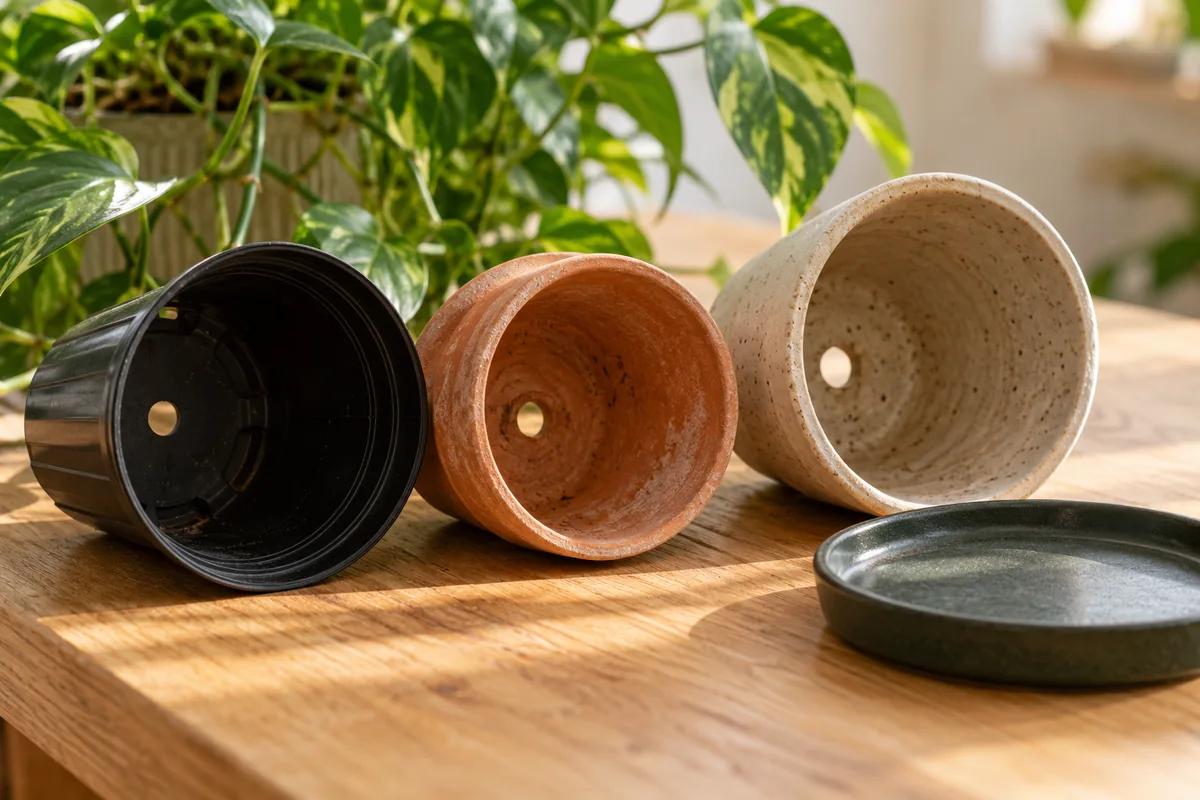
A beautiful planter can hide the most useful part of a growing container: a clear route for excess water to leave. Without that route, each watering adds to a reserve you cannot easily see. The surface may look dry while the lower mix remains saturated. A drainage hole does not guarantee ideal care, but it makes thorough watering and the removal of surplus water much easier. Before planting directly into a container, turn it over and inspect the base. Some pots have a marked opening that must be removed, while others are intended only as decorative covers around a separate nursery pot.
When water moves through potting mix, some remains held among the particles and some drains away. Roots use moisture from that retained supply while also needing air in the surrounding spaces. A container with an open outlet allows freely draining water to escape after a thorough watering. The mix still retains moisture according to its texture, so drainage does not mean the pot becomes dry immediately. Fine ingredients can hold considerable water even in a pot with several holes. This is why the growing medium, container size, and watering threshold need to work together. No single opening can compensate for every mismatch inside the root zone.
Keep the openings functional. Place the pot where its base is not pressed tightly against a flat surface that blocks the outlet. Many nursery containers have raised feet or channels for this reason. Check that a saucer has enough space to receive the initial runoff, then empty it after the pot finishes draining. Roots can sometimes grow through holes and into water collected below, making the arrangement behave differently from an ordinary drained container. Inspect beneath the pot during care, particularly when it has remained in the same cover for months. A hidden tangle of roots and old debris can make a familiar watering routine less predictable.
A layer of stones in a pot without holes does not provide a true exit. Water simply collects in the container beneath or among the stones, and the reduced depth leaves less useful mix for roots. Even in a container with holes, a coarse stone layer changes the boundary between materials instead of reliably improving the behavior of the mix above. Use an appropriate growing medium throughout the root zone and let the container's openings handle surplus water. A small piece of open mesh can keep loose material from falling through a large hole, provided the mesh does not form a dense barrier that traps water or becomes clogged.
Decorative containers without openings work well as outer covers. Keep the plant in a separate inner pot that can be lifted out for watering and inspection. Water over a sink or suitable tray, allow drainage to finish, and return the inner pot to the cover after emptying any collected water. If you water in place, check the bottom of the cover afterward rather than assuming the runoff has disappeared. A spacer can keep the nursery pot above a small accidental puddle, but it is not a reason to leave standing water indefinitely. Make sure the cover is wide enough that the inner pot can be removed without pulling on stems.
Some specialized growing systems intentionally hold a reservoir, yet they are designed around that method. Their planting medium, water level, air space, and plant selection differ from a conventional pot placed in a sealed bowl. Follow the instructions for the actual system and test its behavior before relying on it during an absence. Do not copy one feature, such as a water reservoir, while ignoring the rest of the design. An ordinary houseplant in dense mix can remain too wet when its base is continually submerged. The useful question is how the whole root environment works, not whether water is visible somewhere beneath the plant.
If you want to add drainage to a container, first consider whether its material can be drilled appropriately and whether you can do the work with suitable tools and protection. Glazed ceramic, glass, metal, and plastic require different methods, and some containers crack or lose their finish. A separate inner pot may be simpler and more reversible. Avoid drilling a container while a plant is still inside it. Remove the plant and all growing medium before any modification, clean away debris, and inspect the finished opening. The resulting pot should sit securely and drain freely without sharp edges or loose fragments near the root zone.
During routine care, treat drainage as an observation you can verify. Watch where the water exits, how quickly the pot stops dripping, and whether the saucer fills again later. If a pot remains unusually heavy, check its outlet and outer cover before changing the watering schedule. Keep the growing medium suited to the species and leave enough room below the rim for controlled watering. A straightforward drained container is easier to understand because surplus water has an obvious destination. That clarity helps you water thoroughly when needed and then allow the appropriate drying interval without a hidden pool undoing the rest of your care.