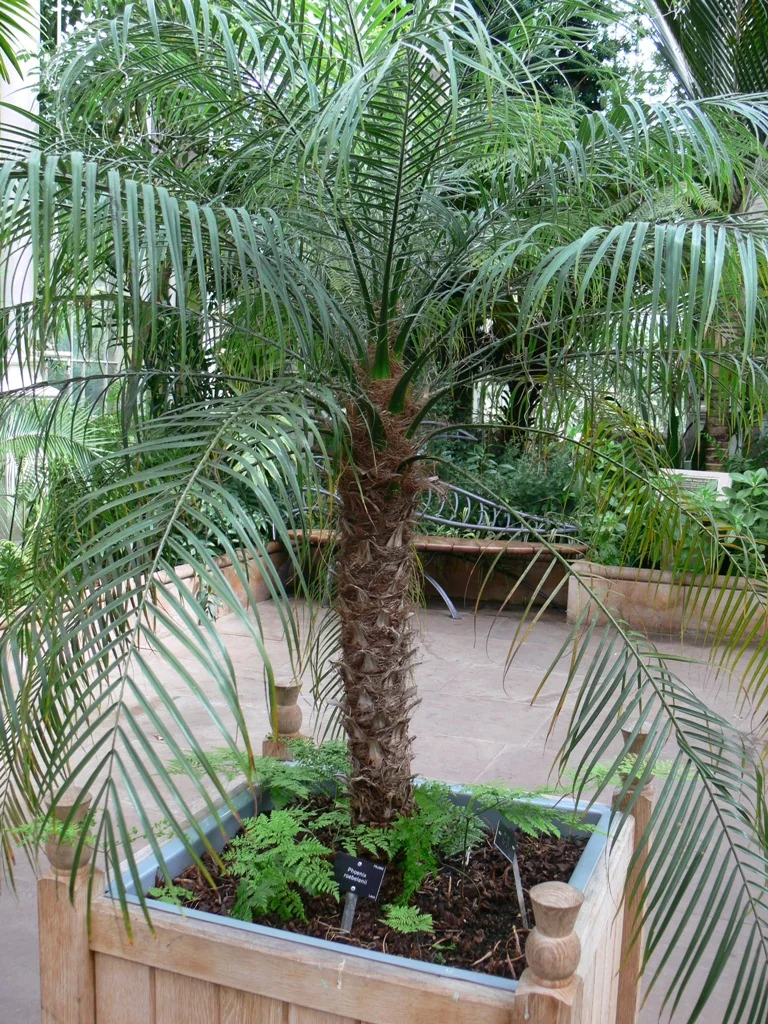
A Small Date Palm Is Still a Substantial Plant
The word pygmy can create misleading expectations about Phoenix roebelenii. It is smaller than the great landscape date palms, yet an established plant still develops a trunk and a broad canopy of finely divided fronds. Its graceful outline makes it attractive in a bright interior, but its leaf bases carry sharp spines that deserve as much attention as its soft-looking tips. This is a palm for an agreed position with clear space, not a safe filler beside every seat or doorway. Assess the complete mature canopy and the routes people use around it before choosing a container specimen.
The species originates in parts of southern China and Southeast Asia, associated with river environments. Its name honors the plant collector Carl Roebelen. The date-palm connection is botanical, but a potted specimen should not be presented as a source of supermarket dates. Those familiar fruits belong to another species and a very different agricultural setting. Nursery pots also vary in arrangement: several trunks may be deliberately combined to create a fuller display. That grouping should be identified before the plant is treated as a naturally compact clump that can be pruned or divided without understanding the individual stems.
Light and Moisture beyond the Nursery
Provide medium to high indoor light, ideally close to generous windows with protection from the harshest unfamiliar afternoon sun. A bright conservatory or sheltered glazed lounge can suit it. A low-light office corner is a poor long-term choice, even if the arching fronds initially remain attractive there. Acclimate the plant after purchase, especially if it will spend summer outside. Check that fronds cannot brush people using the room. The spines are concentrated near their bases, where someone may reach while moving the pot, so a location that keeps the canopy clear but leaves no access to the container is also impractical.
During active growth, keep the medium moderately moist while allowing some upper-layer drying. Water thoroughly and let the surplus drain rather than leaving a shallow reservoir in the cover. A well-rooted palm may use a meaningful quantity in bright summer conditions, whereas the same container needs less in a cool, dim season. Check the central root mass rather than only the newest loose compost around its edge. If water runs rapidly through a dried root ball, verify that the roots have actually been rehydrated. Repeated small splashes can conceal both dry pockets and a wet lower layer.
Container Work around Spiny Leaf Bases
Use a draining pot with an open medium that retains useful moisture. This palm generally does not require frequent disturbance just because a few roots become visible. When repotting is warranted, protect hands and arms from the leaf-base spines, support the root mass, and keep the trunk at its former planting depth. A modest pot increase is easier to manage than a huge volume of damp fresh compost. Have the new container and drainage arrangement ready before moving a heavy specimen. Plan where hands will go during lifting rather than grasping blindly among the petioles for an apparently convenient handle.
Pruning should remove only material that genuinely needs to go. A partly green frond still contributes to the palm and should not be sacrificed automatically because a few tips are brown. Completely spent lower fronds can be removed with appropriate protection and clean tools, avoiding cuts into the trunk. Never cut the central spear to reduce height. A date palm does not branch from that wound like a conventional woody shrub. Do not strip a canopy into a narrow upright tuft to make it pass through a crowded room; reduce the surrounding obstruction or reconsider the location instead.
Feeding, Dry Air, and the Condition of New Spears
Feed moderately during active growth with a suitable labelled fertilizer. Container palms can develop nutritional problems, but leaf color alone rarely supplies a complete diagnosis. Check for accumulated salts, inconsistent moisture, and poor roots when several fronds decline. If fresh compost already contains feed, factor that into the plan. Indoors, slower growth requires less input than nursery production. A useful record includes the condition of each newly opened spear. Stable healthy new foliage provides better evidence that the routine works than whether the oldest transported leaves retain every perfect leaflet through their entire remaining lifespan.
Pay attention to the air around the foliage. A dry heating stream can mark tips and encourage mite problems, while a cold draft can damage a palm accustomed to warm production. Inspect undersides and petiole bases for scale and other pests when a new plant arrives. If an infestation is found, isolate it while identifying the issue and a suitable treatment. Do not attempt to solve all browning by misting repeatedly. Water on the leaves does not correct a saturated root ball, and a brief spray does not necessarily change the humidity of a large room for a useful length of time.
An Agreed Gift with Safe Handling Space
As a gift, pygmy date palm is best discussed beforehand. Its association with the date-palm family may invite a personal message of hospitality or a warm welcome, but there is no need to promise abundance or prosperity from an ornamental pot. The recipient needs sufficient light, floor space, and an understanding of the hidden spines. It may be unsuitable where children or animals are likely to push into the canopy. Deliver it with a clear botanical label and instructions for safe handling. A gift that creates an awkward injury risk beside a favorite chair has missed the practical point of thoughtful plant giving.
Over the years, the trunk and canopy will change the way the plant occupies its setting. Allow enough space for new fronds and make drainage access part of the furniture layout. If the plant becomes difficult to move safely, arrange assistance rather than improvising a grip among the spiny leaf bases. Protect it from abrupt exposure changes during transport or seasonal relocation. Phoenix roebelenii can provide a refined palm silhouette in a suitable bright interior, but the miniature impression is relative. Respecting its roots, mature spread, and defensive leaf bases is what turns an attractive purchase into a sustainable living display. Keep a safe lifting route available as its weight gradually increases.