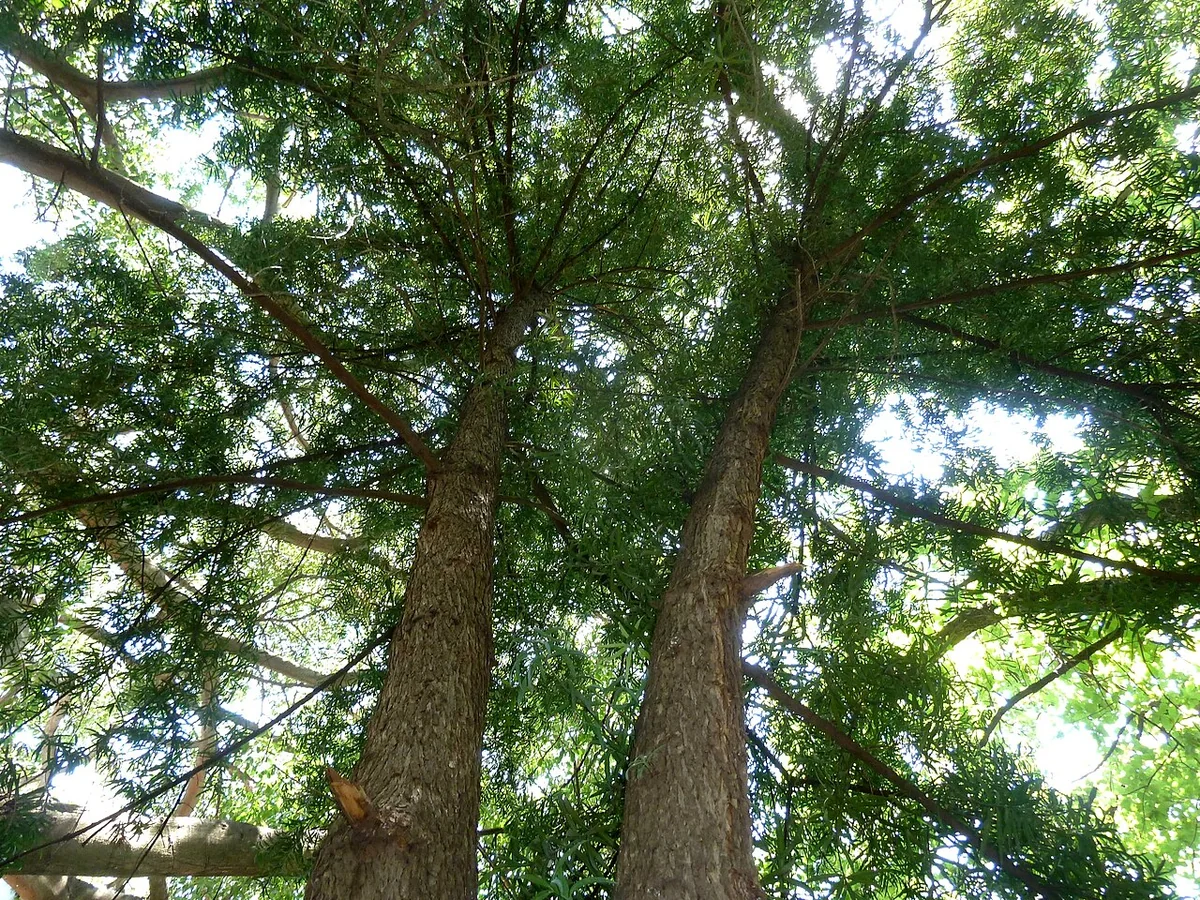
Pendant leaves from South African forests
Henkel's yellowwood is a South African forest conifer with long glossy leaves that droop from the ends of its twigs. Podocarpus henkelii is native particularly to moist forests of the eastern part of South Africa, including the Eastern Cape and KwaZulu Natal. Mature trees can develop a tall trunk and a dense elegant crown, so a potted young specimen represents an early stage of a substantial tree. Its inclusion in an indoor collection should be qualified accordingly. A bright conservatory or protected botanical growing area is a more realistic setting than an ordinary low light office, even though the species can make an attractive container subject.
The leaf form offers a useful distinction from several related yellowwoods. The relatively long pointed blades hang noticeably, while new growth is paler and softer before it matures. That contrast should not automatically be mistaken for a nutrient problem. When selecting a plant, examine its central framework, the living tips, and the condition of lower branches. A nursery label is valuable because several podocarps are sold under simplified common names. The species was named for the forester J. S. Henkel, a documented naming history that can be shared accurately without inventing an association with a family unrelated to the recipient or the tree's origin.
Light and a workable indoor position
Light should be assessed as the limiting resource indoors. The tree needs a generous bright position where enough daylight reaches its interior foliage. Outdoor tolerance of some shade does not mean that it will maintain a dense crown far back from a window. A protected glazed room can offer a better balance of light and temperature, provided the lowest winter conditions are suitable for the container. Acclimate a nursery specimen gradually to stronger sun rather than pressing its soft new growth against hot glass. Watch the arrangement of new leaves and the retention of old foliage to judge whether the environment can support the form being maintained.
Water, roots, and a draining container
Its moist forest background makes regular root observation especially important. Check the upper mix and deeper moisture, then water the whole ball when needed, allowing excess to drain. Do not repeatedly dry a small pot completely in an attempt to exploit the drought tolerance sometimes mentioned for established landscape trees. A restricted indoor root system has a different reserve. Equally, keep the container out of standing water and avoid a compacted saturated lower layer. The useful aim is a root zone with both moisture and air. A large canopy in a small pot can require frequent inspection during warm growth, while winter use can be much slower.
A stable open container mix and an appropriate pot size make those checks more predictable. Repot when the roots fill their present space and the current medium or irrigation pattern is no longer satisfactory. Increase the volume moderately, retain the existing stem depth, and handle the ball without stripping away every fine root. A decorative tub may provide visual balance, but it should not dictate a huge unused volume of damp compost. An inner pot with accessible drainage is often more practical. Keep the base visible and plan how the tree will be moved before increasing the weight beyond what the owner can maintain comfortably.
Training and ongoing maintenance
Pruning should follow a chosen framework rather than an attempt to make the species permanently miniature. Selected shoots can be shortened while useful living foliage remains, and a young leader may be guided rather than removed without thought. A mature bare interior is not guaranteed to regenerate promptly under limited indoor light. If formal shaping is desired, make changes while the plant is strong enough to respond and avoid simultaneous major root disturbance. Remove damaged or dead material carefully. The attractive pendant leaves are part of the species' character, so a natural loose outline may be more convincing than a rigidly clipped surface that hides all of that movement.
Clean dust from the leaves with gentle support for each twig. Inspect the undersides and junctions for scale, mealybugs, or mites, particularly after the plant has spent time in a mixed collection. New growth colour should be considered before diagnosing a deficiency, while persistent yellowing requires a review of roots and environment. Feed modestly during an active period and follow the product instructions for container plants. A forest tree's potential outdoor growth does not justify strong feeding in a room. Temperature stability and freedom from a direct heater blast help keep the fine new growth from becoming damaged before it has matured.
Seed biology is interesting but should remain separate from the expectations for an indoor foliage tree. Male and female reproductive structures occur on different plants, and the seeds need appropriate handling and freshness when propagation is attempted. A young interior specimen is not expected to provide a regular seed crop. Do not use a lack of reproductive growth as a reason to force the plant with fertilizer. Treat foliage and reproductive material as ornamental rather than as household food, and prevent casual chewing by pets or children. Any attempt to collect plant material from the wild must also respect the tree's protected status and local rules.
Meaning without unsupported promises
Yellowwoods have an established place in South African botanical and cultural identity, and the group is associated with the country's national tree symbolism. It is important not to turn that group association into a claim that every yellowwood species has identical status or meaning in every community. A gift of Henkel's yellowwood may personally honour an interest in South African forests, conservation, or a remembered landscape. Explain which part is documented and which part is the giver's own interpretation. The species' real naming history and its forest ecology provide enough depth without adding unsupported promises of protection, health, or longevity for the recipient.
A gift matched to the recipient
This is a specialist gift for someone with a bright conservatory, an appropriate protected collection, or a genuine interest in southern African conifers. It can mark a collection anniversary or a milestone connected with conservation, provided the owner has requested it. It is not a good surprise for a dark desk or a small room where its mature direction has not been considered. Choose legally sourced nursery material, retain the precise label, and discuss eventual size and maintenance access. A smaller vigorous tree is often more useful than an impressive difficult specimen. The meaningful gesture is a well matched living plant accompanied by an honest account of its requirements.