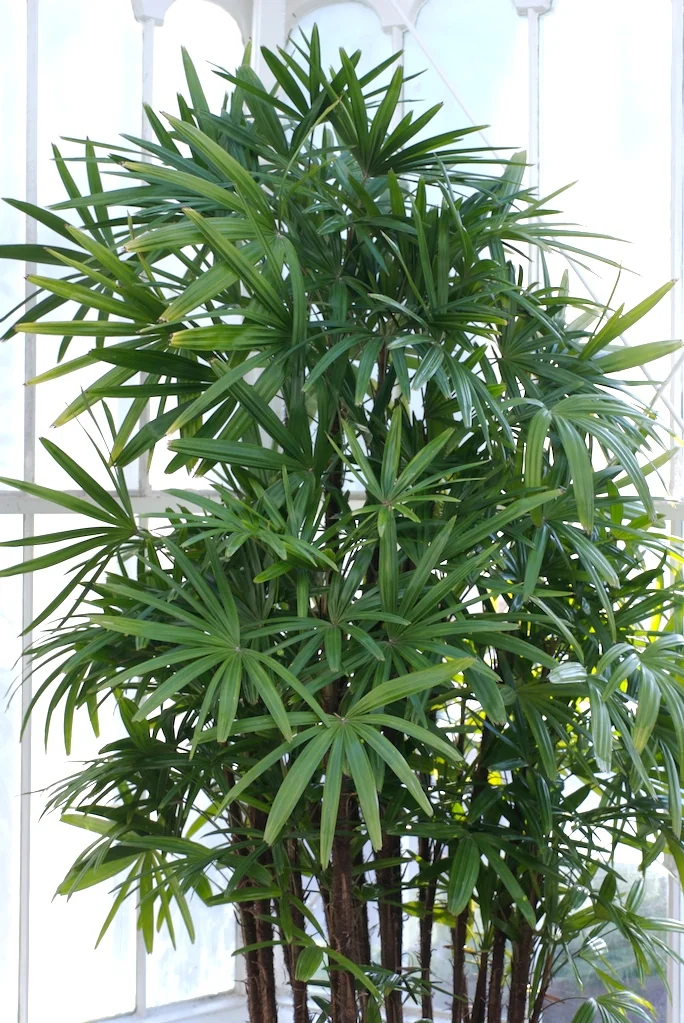
Fans, Fibers, and a Cultivated Clump
Rhapis excelsa has a visual rhythm unlike the soft feathered palms commonly sold for interiors. Its dark fan-shaped leaves divide into broad segments, and their straight-cut-looking ends create a strong graphic outline. Thin canes retain a fibrous covering, while underground rhizomes allow the plant to form a clump. A good specimen can therefore provide both upright structure and repeated leaf shapes without resembling a miniature coconut tree. In an office, it is useful where a firm outline is wanted near a seating area, provided the canopy and spreading base have the physical room they need.
The species is associated with southern China and Vietnam and has a long history of cultivation as an ornamental palm. Named and variegated forms can be prized collection plants, but a plain green lady palm is not an inferior version. Its simpler foliage is often more practical for a lasting interior display. The name excelsa points toward height rather than guaranteeing that every container specimen will become large quickly. Ask whether a nursery plant is one connected clump, several divisions combined, or multiple seedlings. That information affects future division and the way the pot gradually fills with canes.
A Lasting Office Position
Lady palm is relatively accommodating indoors, accepting indirect light and lower illumination than many conspicuous conservatory palms. Nevertheless, a position with real daylight generally maintains a more satisfying display than a deep interior corner. A bright office with filtered window light is appropriate; a dark corridor requires a considered lighting solution. The stiff fans can project into circulation routes, so measure the spread at leaf height as well as the pot on the floor. Place it where doors and passing bags do not repeatedly catch the segment tips. Shade tolerance does not make physical damage less visible on a rigid leaf.
Water the root ball thoroughly after the upper medium has begun to dry, then remove excess from the cover or saucer. A clump with many canes may use a meaningful amount of water in summer, while the same pot can stay damp much longer during a quiet winter interval. Check the center and edge of the container if water distribution seems uneven. An old, densely rooted core may behave differently from freshly added compost. Avoid keeping the outer pot permanently filled as an insurance against forgetting. Stable moderate moisture and a supply of air around the roots are more useful than a hidden reservoir of stale water.
Rhizomes and Selective Maintenance
Use a draining, organic container medium that remains open as it ages. Rhizomes need room to extend, but a leap into a much larger planter can complicate watering. Move up only when crowding or declining medium warrants it. Retain the original depth around the cane bases and keep fibrous stems from being buried under a decorative wet top layer. If a large clump is divided, each portion should retain several canes and a worthwhile root system. Small pieces may survive, but they take longer to regain a balanced display. Plan division as plant propagation rather than an improvised way to fit the same plant back into a tiny pot.
Its tolerance and durability do not remove the need for maintenance. Dust accumulates across the broad fan segments and can be wiped away with a damp cloth while supporting the leaf. Older brown fronds can be cut carefully near their origin without shaving living cane tissue. Do not trim an entire green fan into a smaller circle to force it inside a narrow space. The cut segments remain damaged, and new leaves cannot undo that outline. If a cane is excessively tall for the setting, removing the whole cane from a substantial clump may be possible, but relocation should be considered before sacrificing established growth.
Nutrients, Salts, and Scale on Fibrous Canes
Feeding is best kept proportionate to the plant's pace. A balanced suitable fertilizer during active growth can support new leaves and rhizomes, but overfeeding a slow shaded specimen encourages salt problems rather than rapid improvement. Read the label and account for nutrients in fresh mix. Brown tips may also reflect inconsistent moisture or poor roots. Inspect recent leaves and the history of the container before identifying a specific shortage. Where local water is highly mineralized, occasional thorough drainage helps prevent accumulation. Any flushing needs a real outlet; adding more water to a sealed cover merely redistributes the same problem.
Scale insects deserve particular attention on lady palm because canes, leaf bases, and the undersides of segments offer sheltered sites. Check new stock before placing it beside a long-established indoor collection. A few sticky spots or persistent dark residue should prompt closer inspection rather than repeated cosmetic cleaning alone. Identify the pest and isolate the pot if necessary. Fronds can also brown after cold transport or sudden direct sun, which requires a different response. The pattern matters: damage confined to exposed outer leaves tells a different story from deteriorating new growth at several cane tops.
A Living Screen as an Agreed Gift
This palm can be an appropriate gift for a settled household, a new reception space, or someone who appreciates formal foliage. Its repeated fans may personally suggest order, continuity, or a group working together. Those are visual interpretations rather than promises that the plant will deliver wealth or good fortune. Give a size the recipient can move and water safely. For an office gift, find out who has responsibility during closures and whether the planter can drain without damaging the floor. A modest green clump with an accessible inner pot may be more considerate than a spectacular specimen that needs professional handling from the start.
The long view is a steadily renewing clump with canes of different ages. An occasional older stem retiring does not mean the entire palm needs replacing. Keep enough open space to see new shoots and remove loose debris before it accumulates against the base. When growth eventually exceeds the original footprint, a planned division or change of location can preserve much of the plant's value. Rhapis excelsa rewards an owner who understands that a living screen develops gradually, and that its enduring appeal lies in the relationship between dark fans, fibrous canes, and the room around them.