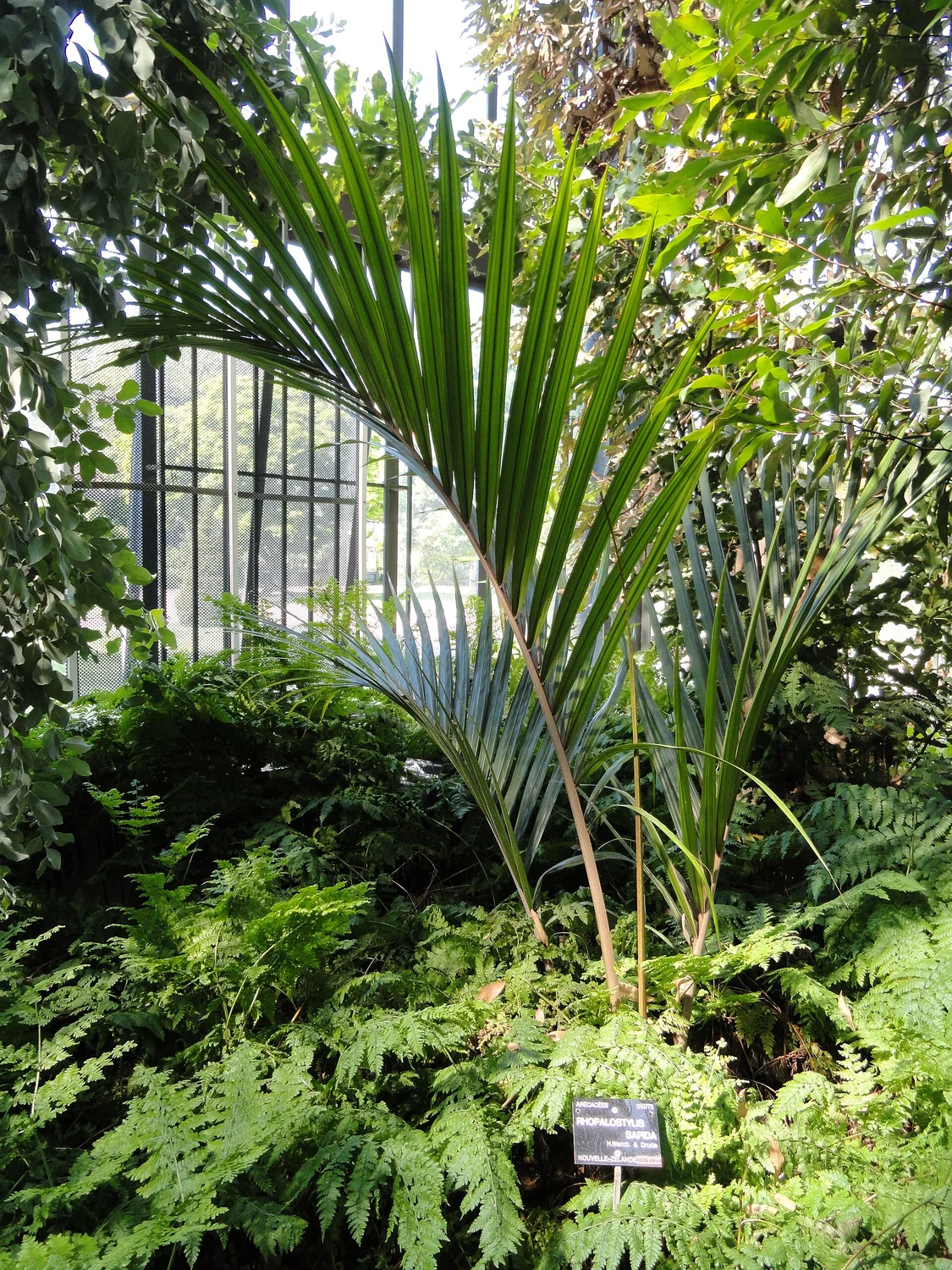
New Zealand Origins and an Upright Crown
Nikau palm has a distinctive upright character, with closely arranged leaflets and a canopy that can appear more vertical than the relaxed outline of a kentia. Rhopalostylis sapida eventually becomes a substantial trunked palm, but young plants can be cultivated in containers for an extended period. Its value indoors lies in that developing forest architecture rather than an expectation that it will remain a tiny desk plant. A cool, bright collection space can be appropriate. A hot, dry office with little daylight is a poor substitute, even though the palm's unfamiliar name and elegant leaves might make it an appealing decorative purchase.
The species is endemic to New Zealand, growing in coastal and lowland forests in warmer parts of the country and on associated islands. Its identity is connected with a specific native flora rather than a generic tropical origin. The Maori name nikau is widely used in horticulture, and retaining it alongside the scientific name acknowledges that geographic context. Mature wild palms have a ringed trunk, a prominent crownshaft, and much larger leaves than young pots. Do not use a photograph of a forest adult as evidence that an indoor seedling is already a miniature version of every mature structural feature.
A Cooler Bright Growing Space
Choose filtered brightness and a relatively moderate climate. A sheltered conservatory that does not become excessively hot, or a bright cool room away from drying equipment, is a more plausible setting than a permanently heated interior corner. Sun through glass can raise leaf and pot temperatures sharply, so check the actual location during the warmest part of the day. Young palms appreciate protection while acclimating to stronger light. Space above the emerging spear is important because a new frond extends upward before taking on its final outline. The finished position should be selected around that movement rather than only the existing crown.
Keep the root ball reasonably moist while allowing drainage and avoiding stale saturation. The fine balance changes with light and temperature: cool conditions reduce water demand, while warm bright growth can use moisture more quickly. Feel the medium carefully and inspect the container's weight if it can be moved safely. A palm standing in a closed outer pot may remain wet below the roots even when its top layer looks dry. Conversely, water may bypass a shrunken dry core. Check whether the occupied root ball is actually taking up the application before returning it to the display and assuming the task is complete.
Root Depth without Repeated Disturbance
Root handling is a particularly important part of nikau cultivation. New Zealand conservation guidance emphasizes avoiding unnecessary disturbance and preserving the important downward root structure in young plants. Use an adequately deep pot and plan repotting before the root ball becomes impossible to remove intact. Have the next container ready so roots do not remain exposed while equipment is found. Keep the palm at its former depth and settle the medium gently. A young plant should not be repeatedly lifted for inspection just because its foliage grows slowly. The lack of rapid visible change is not a reason to disturb a functioning root system.
An open organic mix can provide moisture retention without becoming a compacted block. The container should have working drainage and enough stability for the upright canopy. Avoid a large jump in size that leaves unoccupied wet compost around a limited root mass. During a cool season, reduce watering frequency rather than trying to warm the plant with heavy feeding. Where air becomes dry, improve the growing environment thoughtfully instead of relying on frequent misting alone. Gentle ventilation and steady access to moisture are different from a direct fan blasting the leaflets or a sealed enclosure that traps stagnant humid air around the crown.
Crown Preservation in a Cooler Growing Cycle
Trim only genuinely spent foliage, preserving green leaves and the central growing point. A solitary nikau cannot be brought below a ceiling by cutting off its crown. If the plant eventually becomes too large, a more suitable location is the realistic answer. Cleaning should be gentle, supporting sections of frond so that closely arranged leaflets are not pulled against their natural direction. Feed modestly while there is active growth, using a suitable labelled product. A slow indoor response should not provoke repeated strong applications. Compare new leaves across several months before deciding whether a change in the routine has helped.
Inspect the leaf undersides and petiole bases for pests, particularly when the plant joins a warm mixed collection. Mite stippling, scale, and accumulated dust can be confused from a distance. Identify any issue before treatment and keep affected plants separate while assessing the response. Also review temperature history if a whole exposed side deteriorates after a move. Young nikau may respond poorly to a hot, dry microclimate even when the root ball has been watered. Correcting the placement is more useful than repeatedly cutting off the resulting brown tips and leaving the same environmental mismatch in place.
A Gift Connected with Place
As a gift, nikau is especially meaningful for someone with a connection to New Zealand or a serious interest in regional botany. It can personally express an appreciation of place, continuity, or forest conservation. Those ideas should not be presented as a fixed Maori gift code or an invented traditional blessing. Ask whether the recipient has the cooler bright conditions and patience the palm deserves. A clearly identified nursery-grown plant is preferable to material of uncertain origin. Include a note about gentle root handling and future height, so the botanical story comes with practical support rather than a hidden long-term space problem.
The rewarding way to grow nikau is to follow the development of its particular structure. Watch each new spear extend, note how the crown changes, and provide the root depth and climate that allow that progression. Avoid treating it as a disposable tropical backdrop whose health is judged only by the first month after delivery. A young palm may remain a container subject for years, but it still has the trajectory of a forest species. Rhopalostylis sapida is most convincing indoors when its New Zealand origin, solitary growth habit, and sensitivity to unnecessary disturbance are all part of the cultivation plan.